
When the Unthinkable Becomes Contingency: Canada's Quiet Plans for a U.S. Invasion
- Nishadil
- September 25, 2026
- 0 Comments
- 4 minutes read
- 3 Views
- Save
- Follow Topic
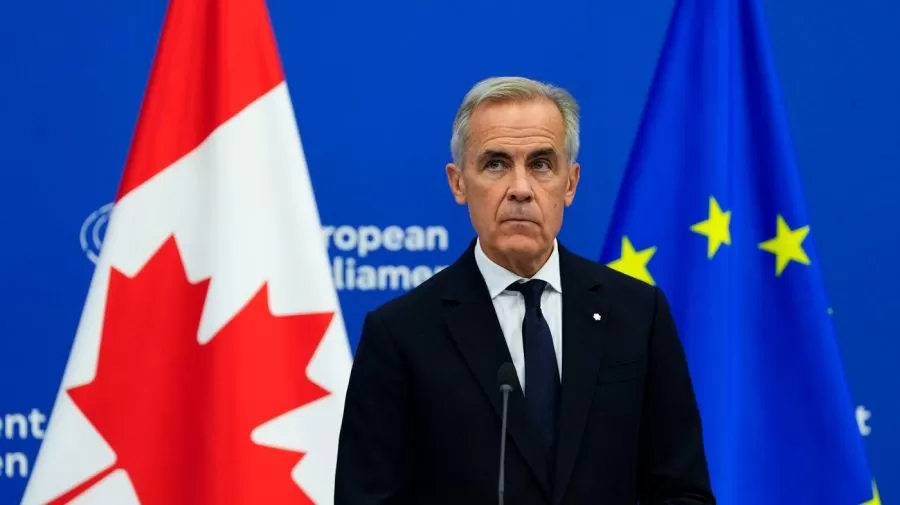
Canada Prepares for 'Extreme Tail Risk' of U.S. Invasion, PM Carney Confirms
Canadian Prime Minister Mark Carney has revealed that his government has undertaken contingency planning for a hypothetical U.S. military invasion, despite calling the scenario 'highly unlikely.' The unusual preparations come amidst lingering echoes of former President Trump's rhetoric and a fascinating historical precedent.
Imagine this: a Canadian Prime Minister, Mark Carney, openly confirming that his government has quietly drawn up contingency plans for something as mind-boggling as a U.S. military invasion. Yes, you read that right. While it sounds like a plot from an alternate history novel, Carney, in an interview with The New York Times on September 24-25, 2026, unequivocally stated that Canada has indeed prepared for what he termed an “extreme tail risk” scenario involving its southern neighbour.
Now, let’s be absolutely clear, Carney isn’t suggesting this is on anyone's bingo card for next Tuesday. He’s consistently labeled this prospect as “highly unlikely,” “not a base case,” and an “extreme tail risk”—a scenario so remote, so far out in left field, that most of us would simply laugh it off. Yet, as he rather pointedly put it, “it would be irresponsible not to” conduct such contingency planning. It’s all about risk management, isn't it? Even the most improbable events sometimes demand a moment of sober consideration.
The elephant in the room, of course, is the recent past. Carney’s acknowledgment of these preparations comes as a lingering echo of former U.S. President Donald Trump’s tenure, a period marked by some rather... unconventional rhetoric regarding Canada. Think about those repeated, almost joking, references to Canada as the “51st state,” or even maps that circulated online, sometimes shared by Trump himself, visually absorbing Canadian territory into the U.S. map. While likely intended as playful jabs, for a head of state, such comments, even in jest, can create an environment where the unthinkable suddenly feels a tiny bit less impossible.
Naturally, the Canadian government has been tight-lipped on the specifics of these defense preparations. Defence Minister David McGuinty mirrored Carney’s stance, emphasizing that all militaries analyze various risk scenarios and this particular one falls firmly into the “tail risk” category. On the U.S. side, the reaction has been one of outright dismissal. Admiral Samuel Paparo, who heads the U.S. Indo-Pacific Command, found the whole notion utterly absurd, brushing it off as “absolutely and utterly preposterous.” And honestly, for most observers, that sentiment rings true.
Fascinatingly, this isn't the first time Canada has quietly contemplated such a wild scenario. Back in 1921, a brilliant but perhaps overly imaginative Lieut.-Col. James “Buster” Sutherland Brown drafted what was famously known as “Defence Scheme No. 1.” This wasn't just a defensive plan; it was an ambitious, even audacious, pre-emptive strike strategy against the U.S. – targeting places like Albany, Minneapolis, Seattle, and Great Falls, Montana, among others. A forgotten piece of history, mentioned in a 2005 Washington Post article and now resurfacing in conversations, it gives you a sense that even the unthinkable has a historical precedent, however remote.
Timothy Sayle, a professor at the Munk School of Global Affairs and Public Policy at the University of Toronto, offers some perspective. He points out that the U.S. has, at times, acted unilaterally in the past, citing incursions and threats in places like Venezuela and Greenland. While a full-scale invasion of Canada seems utterly far-fetched, these historical footnotes might, in some strategic circles, provide a flimsy theoretical basis for why any nation, even one as closely allied as Canada, might feel compelled to consider even the most remote contingencies. It's a testament to the complex and sometimes unpredictable nature of international relations, where even the closest friendships demand a layer of prudent, if improbable, foresight.
Editorial note: Nishadil may use AI assistance for news drafting and formatting. Readers can report issues from this page, and material corrections are reviewed under our editorial standards.










