A Cosmic Enigma Unveiled: Galileo's Close Encounter with Amalthea
- Nishadil
- November 06, 2026
- 0 Comments
- 3 minutes read
- 17 Views
- Save
- Follow Topic
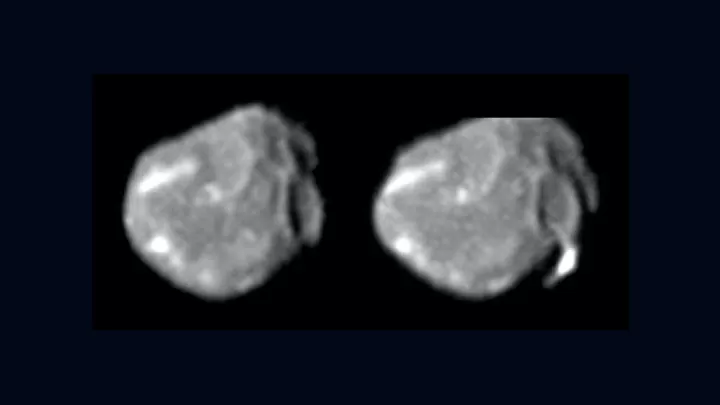
On This Day: Galileo's Daring Flyby of Jupiter's Bizarre Moon, Amalthea
Two decades ago, NASA's Galileo spacecraft made a historic close pass of Jupiter's moon Amalthea, revealing a peculiar 'rubble pile' less dense than water and brimming with mysteries about its fiery nature.
Twenty years ago, on a crisp November 5th in 2002, humanity reached out and touched a piece of Jupiter’s intricate dance, not with a hand, of course, but through the remarkable eyes and instruments of NASA’s Galileo spacecraft. This particular day marked a daring, close-range flyby of Amalthea, one of Jupiter's innermost moons, a celestial body that, frankly, turned out to be far more peculiar than anyone had initially imagined. It was a moment of scientific triumph, peeling back a layer of mystery from our solar system's colossal gas giant.
Galileo, a true workhorse of space exploration, swept past Amalthea, gathering crucial data that would reshape our understanding of this diminutive satellite. What it revealed was nothing short of astonishing: Amalthea isn't a solid, monolithic rock, as one might assume. Instead, the data painted a picture of a loose "pile of icy rubble," a cosmic collection of fragments barely holding itself together. Torrence Johnson, a project scientist for the Galileo mission at JPL, would later confirm just how strange this was in May 2005, highlighting that Amalthea's density is incredibly low—so surprisingly lightweight, in fact, that it’s less dense than water itself. Imagine that for a moon!
But the revelations didn't stop there. Amalthea, it turns out, is quite the anomaly. For starters, it holds the rather striking title of being the reddest object in our entire solar system. You heard that right, the reddest! And as if its unusual color wasn't enough, this small moon generates more heat internally than it actually receives from the distant sun. Scientists are still pondering the exact mechanisms behind this, but a leading hypothesis suggests Amalthea is creating electrical currents as it zips around within Jupiter's incredibly powerful magnetic field, perhaps explaining some of that internal warmth. It's a true puzzle, indeed.
Measuring in at approximately 168 miles long, this little oddball orbits Jupiter at a relatively close distance of about 112,468 miles (or 181,000 kilometers, if you prefer). Its composition, based on Galileo's findings and subsequent analysis, probably contains a good deal of water ice, alongside various rocky materials. This combination, coupled with its "rubble pile" structure, suggests a violent past, perhaps repeatedly shattered and re-accreted over cosmic eons. It’s a testament to the dynamic nature of planetary systems.
Of course, Amalthea wasn't a complete stranger before Galileo's visit. This intriguing moon was first spotted by the astute astronomer Edward Emerson Barnard back in September of 1892. He made his discovery using the magnificent Lick Observatory telescope, nestled high in California. Initially designated "Jupiter V" (the fifth moon discovered orbiting the gas giant), it was later bestowed the more evocative name Amalthea, after a kind naiad—a water nymph from ancient Greek mythology—who, legend has it, nursed the infant Zeus (the Roman equivalent of Jupiter) with goat's milk. A fitting name, don't you think, for a moon tied so closely to the king of the gods?
While Amalthea continues its silent, fiery orbit around Jupiter, Galileo's own journey eventually came to a dramatic, yet planned, end. After years of incredible service, gathering unparalleled data from the Jovian system, the spacecraft was intentionally plunged into Jupiter’s crushing atmosphere on September 21, 2005. It was a controlled descent, ensuring no earthly microbes could contaminate potentially habitable moons like Europa. But the data it sent back, particularly from that daring Amalthea flyby, remains a cornerstone of our understanding of these distant, bewildering worlds. What a mission, what a legacy.
Editorial note: Nishadil may use AI assistance for news drafting and formatting. Readers can report issues from this page, and material corrections are reviewed under our editorial standards.