The Fascinating World of Chords in a Circle
- Nishadil
- November 29, 2026
- 0 Comments
- 6 minutes read
- 9 Views
- Save
- Follow Topic
Unraveling the Secrets of Circular Chords: What They Are and Why They Matter
Discover what a chord of a circle is, its crucial properties, and how these fundamental concepts underpin much of geometry. From simple definitions to powerful theorems, we'll explore the straight lines that connect points on a circle's edge.
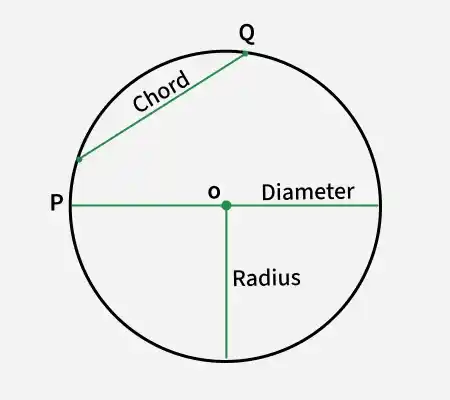
Ever gazed at a circle and wondered about the straight lines that can be drawn inside it? Well, you're probably thinking about chords! Simply put, a chord of a circle is nothing more than a straight line segment that gracefully connects any two distinct points right on the circle's edge, its circumference. It’s a pretty fundamental concept in geometry, forming the basis for so many other ideas.
And here’s a neat little fact for you: the absolute longest chord you can draw within any given circle is its diameter. You know, that special line that cuts straight through the circle’s very center? That’s it! It’s unique because it perfectly divides the circle into two equal halves, passing right through the heart of the shape. All other chords are, by definition, shorter than the diameter.
Now, how do we actually measure these chords? Luckily, mathematics provides us with a couple of handy tools, depending on what information you already have. One popular method leans on the good old Pythagorean Theorem. If you know the circle's radius (let's call it `r`) and the perpendicular distance from the center of the circle to the chord (we'll use `d` for that), you can find the chord's length using the formula: `2√(r² - d²)`. It's quite elegant how it all comes together, isn't it?
Alternatively, if you're dealing with angles, the Law of Cosines comes into play. If you know the radius (`r`) and the angle (`θ`) that the chord subtends at the center of the circle – meaning the angle formed by connecting the chord's endpoints to the center – then its length can be calculated as `2r × sin(θ/2)`. It just goes to show there’s often more than one path to the right answer in geometry!
Beyond simple definitions and calculations, chords are incredibly powerful because they adhere to some really interesting and consistent rules – what we call theorems. These aren't just arbitrary rules; they offer profound insights into how circles behave.
One cornerstone theorem states that if you draw a line from the center of a circle and it’s perpendicular to a chord, that line will always, without fail, bisect the chord. That means it cuts it perfectly in half! Pretty useful, right?
Then there’s the relationship between chords and angles. Equal chords within a circle will always subtend equal angles at the center. And conversely, if two chords subtend equal angles at the center, then you can bet they are of equal length. It’s a beautiful symmetry.
Speaking of equality, equal chords also share another special characteristic: they are always equidistant from the center of the circle. This makes intuitive sense when you think about it; perfectly symmetrical chords must be balanced around the center.
And here’s a theorem that’s a bit different but equally important: you can always draw one unique circle through any three given non-collinear points. That is, three points not lying on a single straight line. Try it sometime; it's quite a revelation!
But the story of chords doesn't end with theorems; they have a host of other fascinating properties that help us understand circles more deeply:
Every chord essentially carves up a circle into two distinct parts, or segments: a larger one we call the major segment, and a smaller one, the minor segment. Unless, of course, it's a diameter, in which case it creates two equal semicircles.
If you take a chord and extend it endlessly in both directions, what you end up with is called a secant line. This line, unlike a chord which stops at the circumference, continues indefinitely through and beyond the circle, intersecting it at two points.
When you connect the two endpoints of a chord to the center of the circle, you beautifully form an isosceles triangle. This is because the two lines connecting to the center are, by definition, radii, and all radii in a given circle are equal in length.
That perpendicular bisector we talked about earlier? Well, the perpendicular bisector of any chord will always, without exception, pass right through the very center of the circle. This is a super handy property if you're ever trying to locate a circle's center!
Furthermore, if a radius happens to be perpendicular to a chord, it does double duty: it bisects both the chord and its corresponding arc. It's a true multi-tasker of the circular world.
Here’s another intriguing interaction: when two chords intersect inside a circle, there’s a consistent relationship between their segments. The product of the segments of one chord will always equal the product of the segments of the other chord. It's a neat little proportionality.
And finally, an essential relationship involving angles: the angle that a chord subtends at the center of a circle is precisely twice the angle it subtends at any point on the remaining part of the circumference. This particular property is fundamental to understanding inscribed angles and is often a source of "aha!" moments for geometry students.
So, as you can see, these seemingly simple straight lines within a circle, these chords, are actually packed with mathematical depth and elegance. Understanding them is truly key to unlocking a deeper appreciation for the beauty and logic inherent in geometry.
- India
- News
- Technology
- TechnologyNews
- Circle
- Radius
- Geometry
- GeometricProperties
- PythagoreanTheorem
- Picked
- MathConcepts
- MathsFormulas
- AngleSubtended
- ChordSubtendingAngle
- Diameter
- EquidistantChords
- PropertiesOfChords
- PerpendicularBisector
- EqualChords
- Chord
- ChordLengthCalculation
- GeometryMaq
- LawOfCosines
- ChordLengthFormula
- TheoremsOfChords
- ChordsOfACircle
- CircleGeometry
- CircleTheorems
- MajorSegment
- MinorSegment
- SecantLine
- IsoscelesTriangle
Editorial note: Nishadil may use AI assistance for news drafting and formatting. Readers can report issues from this page, and material corrections are reviewed under our editorial standards.