Willem Einthoven’s Nobel‑Winning Invention That Gave Us the Modern ECG
- Nishadil
- November 08, 2026
- 0 Comments
- 2 minutes read
- 2 Views
- Save
- Follow Topic
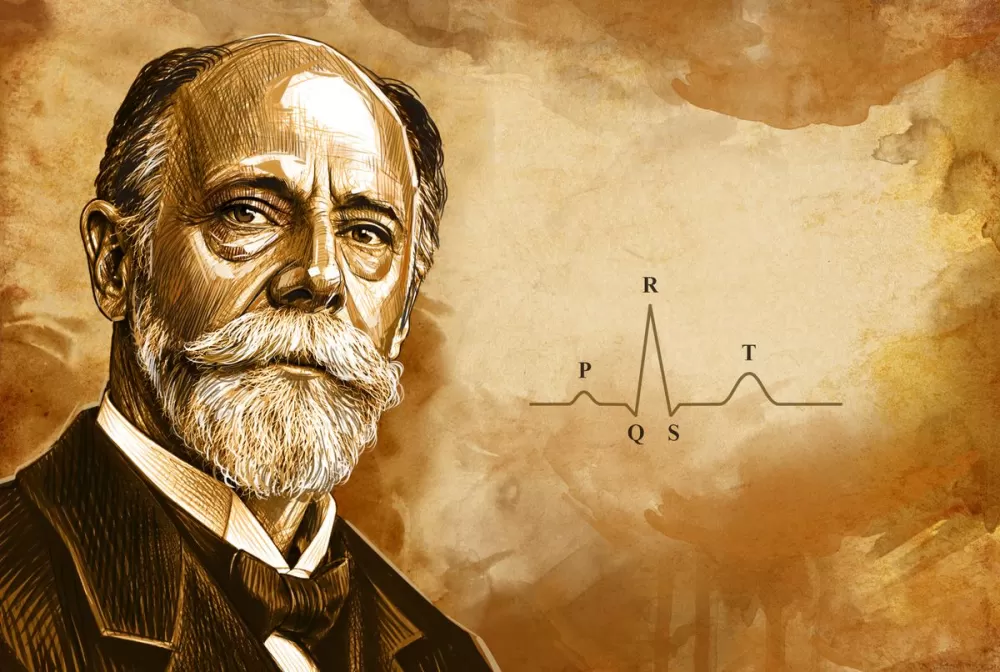
How the Dutch physiologist’s string galvanometer turned heartbeats into readable lines
In 1924 Willem Einthoven won the Nobel Prize for inventing the string galvanometer, a breakthrough that made accurate electrocardiograms possible and reshaped heart medicine.
When Willem Einthoven, a quiet Dutch physician‑physiologist, first hooked a heart up to his new device in the early 1900s, few could have guessed how dramatically it would change medicine. The contraption – a delicate string galvanometer – was nothing short of revolutionary. By letting a thin quartz filament vibrate in response to the heart’s tiny electric currents, it produced a tracing that looked like a scribbled line on paper, yet it was a faithful record of every beat.
It wasn’t just the hardware that mattered. Einthoven also introduced a simple, logical way to read those squiggles. He drew an imaginary triangle connecting the right arm, left arm, and left leg – today known as “Einthoven’s triangle” – and assigned each side a label (P, QRS, T). This gave clinicians a common language to describe what they saw, turning a mysterious scribble into a diagnostic tool.
The impact was immediate. The electrocardiogram, or ECG, became a window into the living heart, allowing doctors to spot arrhythmias, catch the early signs of a blocked artery, and even confirm a past heart attack. Before Einthoven, doctors could only listen with a stethoscope or guess based on symptoms; now they had a visual proof, right on a strip of paper.
Recognition came fast. In 1924 the Nobel Committee honoured Einthoven “for his discovery of the mechanism of the electrocardiogram.” The award wasn’t merely about the invention itself but about the whole framework – the instrument, the method of recording, and the interpretative rules – that together birthed modern electrocardiography.
Today, over a hundred years later, the basic principles Einthoven set up still underpin every bedside monitor, every ambulatory Holter recorder, and every sophisticated cardiac imaging system. Even though today’s machines are digital and far more compact, they all trace their lineage back to that fragile string and the Dutch scientist who dared to listen to the heart’s electric whisper.
So the next time you see those familiar P‑Q‑R‑S‑T waves on a screen, remember the quiet Dutch doctor whose curiosity and persistence gave us a language to talk to the heart itself.
Editorial note: Nishadil may use AI assistance for news drafting and formatting. Readers can report issues from this page, and material corrections are reviewed under our editorial standards.