When Blockchain Data Becomes AI Context, Stale State Turns Into a Security Risk
- Nishadil
- November 07, 2026
- 0 Comments
- 5 minutes read
- 13 Views
- Save
- Follow Topic
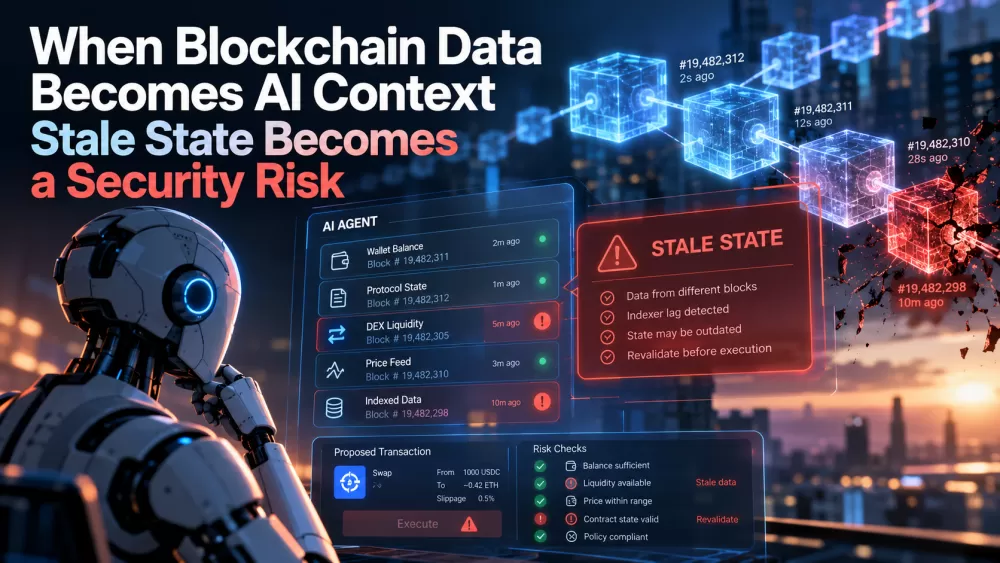
Why AI agents need fresh, trustworthy blockchain data—or they could make costly mistakes.
Combining AI with blockchain sounds easy, but outdated on‑chain data can lead agents to unsafe actions. Learn how to keep context fresh and secure.
At first glance, hooking an AI agent up to a blockchain feels like a perfect match. The chain gives you an immutable ledger; the agent brings reasoning, planning, and the ability to fire off transactions. In theory you say, “let the model read the latest balance, calculate the best move, and hit send.”
Reality, however, is messier. The data the agent pulls may be perfectly correct at the moment of retrieval, yet it can become obsolete the instant the agent starts to think about a transaction. A wallet balance can shift in a heartbeat, a pending transaction may get confirmed, a liquidity pool can dry up, or a lending position can slide toward liquidation. The AI isn’t hallucinating; it’s simply acting on a snapshot that no longer reflects the world.
This subtle mismatch is especially dangerous in finance‑grade blockchain apps. A stale answer in a chat can be corrected with a quick follow‑up, but a stale decision that results in an on‑chain transaction is far harder to unwind. The core problem isn’t a lack of model quality or retrieval accuracy; it’s that the context the model relies on may have lost its validity by the time execution occurs.
Imagine a decentralized‑finance monitoring bot. It checks a wallet’s ETH balance, reads a lending protocol’s collateral ratio, and compares liquidity on two DEXes. Each piece of information comes from a different source—perhaps an RPC node for the balance, an indexer for the lending data, and a price oracle for market rates. All three reads are accurate when they arrive, but they’re taken seconds apart. In those seconds, a large trade could drain the DEX pool, a liquidation could trigger, or another user could move ETH out of the wallet. The bot then builds a transaction that looks sound on paper but is risky in the real, current state.
This is a classic distributed‑systems issue: components see state changes at different times. Blockchains exacerbate it because applications routinely mash together on‑chain reads, event streams, indexed datasets, external feeds, and local caches. Adding an AI layer means the system now has an extra “think‑time” where the data can become stale before the final action is issued.
What’s crucial is distinguishing between data correctness at query time and decision validity at execution time. A node can faithfully report a balance for block #1234567, an indexer can correctly translate events up to that block, and a price feed can deliver the latest ticker. None of those guarantees that the composite view remains reliable a few seconds later when the AI finally signs a transaction.
Managing stale context is hard because blockchain apps rarely rely on a single source. An AI agent might:
- Call
eth_getBalanceon an RPC endpoint to fetch the current balance. - Subscribe to new block headers for real‑time updates.
- Pull historical logs to reconstruct past activity.
- Query an indexing service like The Graph for aggregated state.
- Fetch an external price oracle for market rates.
Each method has its own latency and semantics. RPC calls are near‑real‑time but may be throttled; indexers provide convenient aggregates but lag behind the chain by a few blocks; price oracles update on their own schedule. An application that treats all these answers as interchangeable snapshots is courting danger.
So how can developers mitigate the risk?
- Timestamp every piece of context. Record the block number or wall‑clock time when each datum was fetched.
- Define freshness windows. For high‑risk actions, only accept data that is no older than a few seconds or a single block.
- Re‑validate before execution. Just before signing a transaction, re‑query critical fields—balance, price, liquidity—to ensure nothing shifted.
- Use atomic on‑chain checks. Where possible, embed the safety check inside the smart contract (e.g., require the balance to be ≥ X at execution).
- Employ multi‑source consensus. Compare RPC, indexer, and direct on‑chain reads; if they diverge, flag the context as stale.
In short, context engineering for AI agents in blockchain isn’t just about feeding more data. It’s about treating that data as a representation of a moving state and putting hard limits on how long that representation can be trusted. Only then can we let autonomous agents act with confidence, rather than accident.
Editorial note: Nishadil may use AI assistance for news drafting and formatting. Readers can report issues from this page, and material corrections are reviewed under our editorial standards.