Webb Telescope Catches a Mysterious Flash in an Empty Patch of Sky
- Nishadil
- October 22, 2026
- 0 Comments
- 2 minutes read
- 12 Views
- Save
- Follow Topic
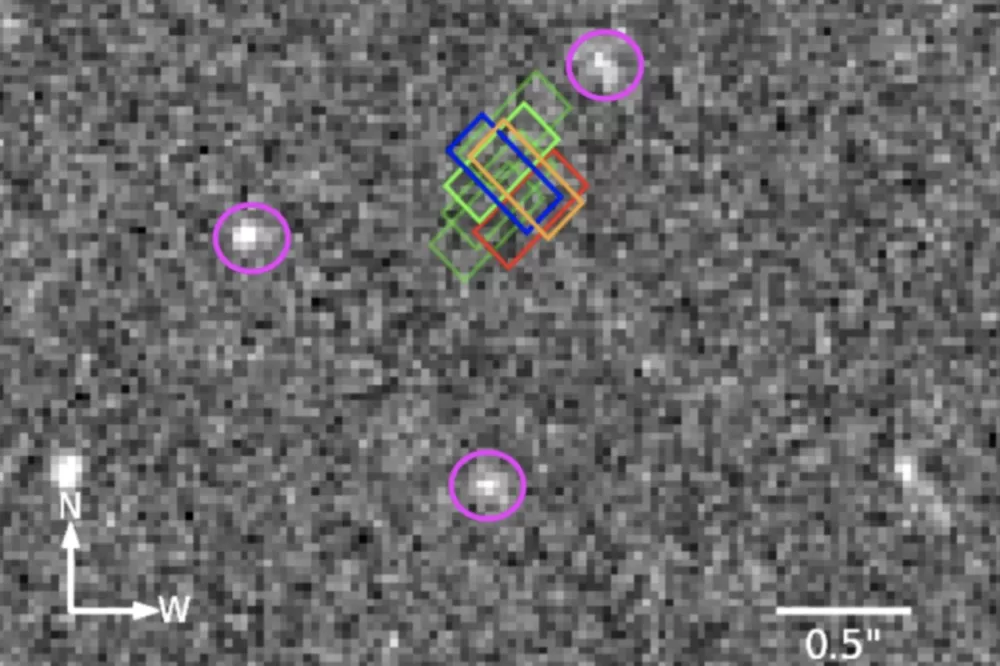
A lone emission line blinks twice in Fornax, leaving astronomers baffled
JWST spotted a single bright emission line in an apparently empty region of Fornax, flashing twice over three months. Its source remains unknown, sparking wild theories.
When a team of astronomers set out to hunt for the earliest galaxies, they didn’t expect to stumble on a single, stubborn glow that seemed to appear out of nowhere. Using the James Webb Space Telescope’s Near‑Infrared Spectrograph (NIRSpec), Mason Huberty and his colleagues at the University of Minnesota pointed the instrument at a quiet corner of the southern constellation Fornax, a spot that had looked completely empty in earlier Hubble and Webb images.
To their surprise, the spectrograph recorded a bright emission line – a sharp spike of light that usually signals the presence of a particular atom or molecule. Even stranger, the line showed up in two separate observation windows, one in August and another in November 2023, roughly 88 days apart. Every other line in the data could be matched to known distant galaxies, but this one stood alone, without any companion lines that might help identify its chemistry or distance.
Emission lines are the workhorses of modern astronomy. By measuring their wavelengths, scientists can infer an object’s composition, its speed, and how far away it lies. In this case, the lone line was bright enough that, if it belonged to a conventional galaxy, that galaxy should have been visible in the images taken before. Yet the sky remained stubbornly dark.
The researchers tossed around a handful of possibilities. One idea is that the signal could come from an ultra‑primitive galaxy that formed just a few hundred million years after the Big Bang – essentially a cosmic newborn. But such a galaxy would likely have left more fingerprints in the spectrum. Another guess is a fading active galactic nucleus, the bright heart of a galaxy powered by a supermassive black hole, now winding down. Yet that scenario usually produces a suite of emission lines, not a lone outlier.
Perhaps the flash originated from a brief, violent event – a star being torn apart by a black hole, or some exotic transient we haven’t seen before. That would explain why nothing was visible a year earlier. Still, each of these explanations brings its own set of puzzles, and the data simply aren’t sufficient to pick a winner.
“Regardless of its true nature, this object is highly unusual and probes extreme physical conditions,” the authors wrote in their Astrophysical Journal paper. For now, the mystery lingers, and astronomers hope that follow‑up observations with JWST or other facilities will finally shed light on what lit up that empty patch of the cosmos.
Editorial note: Nishadil may use AI assistance for news drafting and formatting. Readers can report issues from this page, and material corrections are reviewed under our editorial standards.