
The Spider's Web of Crime: Peruvian Airport Unravels Massive Tarantula Smuggling Plot
- Nishadil
- November 07, 2026
- 0 Comments
- 4 minutes read
- 5 Views
- Save
- Follow Topic
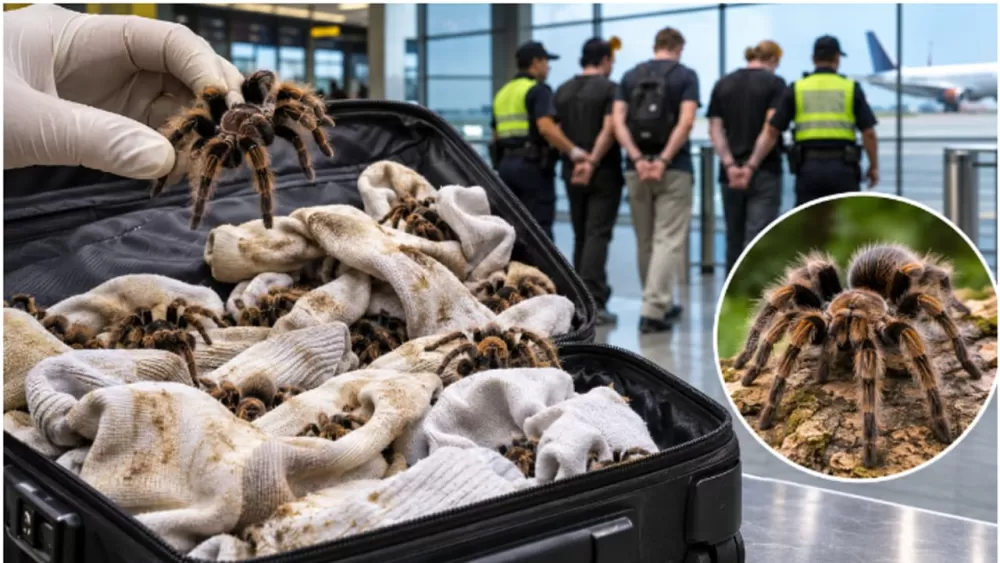
Thousands of Tarantulas, Worth Millions, Seized in Audacious Peru Airport Smuggling Bust
A shocking discovery at Lima's Jorge Chávez International Airport revealed over 3,000 tarantulas, including rare and undescribed species, smuggled in dirty socks. The valuable arachnids were bound for Germany, leading to the arrest of three individuals in a case highlighting the lucrative and destructive illegal wildlife trade.
Picture this: a bustling international airport, the usual cacophony of travelers, luggage carts, and flight announcements. Now, imagine the sudden, unsettling silence that must have fallen when authorities at Lima’s Jorge Chávez International Airport peeled back the layers of three unassuming suitcases. What they uncovered was not clothes, souvenirs, or electronics, but a truly macabre cargo: over 3,000 tarantulas, meticulously, almost disturbingly, hidden away in dirty socks.
This wasn't just a handful of spiders; it was a veritable creeping, crawling menagerie. We're talking about eggs, tiny hatchlings, and fully grown adult specimens, all destined for an illicit journey to Germany. The discovery, which took place on November 5, 2026, and was reported to Agence France-Presse (AFP) the very next day, unveiled an operation of staggering scale and brazenness. It sounds like something straight out of a thriller, yet it’s a stark reality of the persistent illegal wildlife trade.
Officers from the Peruvian National Forestry and Wildlife Service (SERFOR), working alongside a specialized unit of environmental police, made this astonishing find. Their diligence led to the detention of three individuals – two German nationals and one Polish citizen – who now face criminal proceedings. Interestingly, there's even a whisper that one of the suspects might be a prominent tarantula researcher, which, if true, adds a disturbing layer of betrayal to the scientific community and conservation efforts. It really makes you wonder about motives, doesn't it?
Cora Suarez, a wildlife control technician with SERFOR, confirmed the grim details. She noted that these tarantulas hailed from various biodiverse regions of Peru, and, perhaps most crucially, included species "not yet described by science." Think about that for a moment: creatures unknown to formal biology, snatched from their natural habitats for illegal profit. Among the seized arachnids was Pamphobeteus antinous, a magnificent, large tarantula species native to South America. This particular spider is not just beautiful but also classified as threatened and holds protected status under Peruvian law. Its capture and attempted export represent a direct assault on the nation's natural heritage.
The financial incentive behind such a risky endeavor is clear. Authorities estimate the street value of this confiscated spider hoard to be approximately 1.5 million euros on the European black market. A single tarantula, depending on its rarity and size, could fetch upwards of 500 euros. That's a hefty sum for a living creature, driving home the brutal economics of this clandestine industry.
But the consequences for those caught engaging in such illicit activities are severe, as they should be. In Peru, wildlife trafficking carries a prison sentence ranging from three to five years. For cases involving protected species, like the Pamphobeteus antinous found in those dirty socks, that sentence can climb to an even more substantial seven years. It’s a serious deterrent, yet clearly, not enough to stop everyone.
This incident, while dramatic, is just one small piece of a much larger, global puzzle. Illegal wildlife trafficking, according to Interpol, is a monstrous criminal enterprise, generating an estimated $20 billion annually worldwide. It’s not merely a crime against animals; it’s a profound crime against nature, standing as a primary contributor to the alarming rate of biodiversity loss our planet is currently facing. Every tarantula saved, every smuggler apprehended, is a small victory in a battle that truly defines our commitment to preserving the wonders of the natural world for generations to come. It serves as a stark reminder of the hidden dangers lurking in the shadows of international trade, even in something as seemingly innocuous as a dirty sock.
Editorial note: Nishadil may use AI assistance for news drafting and formatting. Readers can report issues from this page, and material corrections are reviewed under our editorial standards.


