The Cosmic ‘Hamburger’ That’s Cooking Up a Baby Gas Giant
- Nishadil
- October 22, 2026
- 0 Comments
- 3 minutes read
- 4 Views
- Save
- Follow Topic
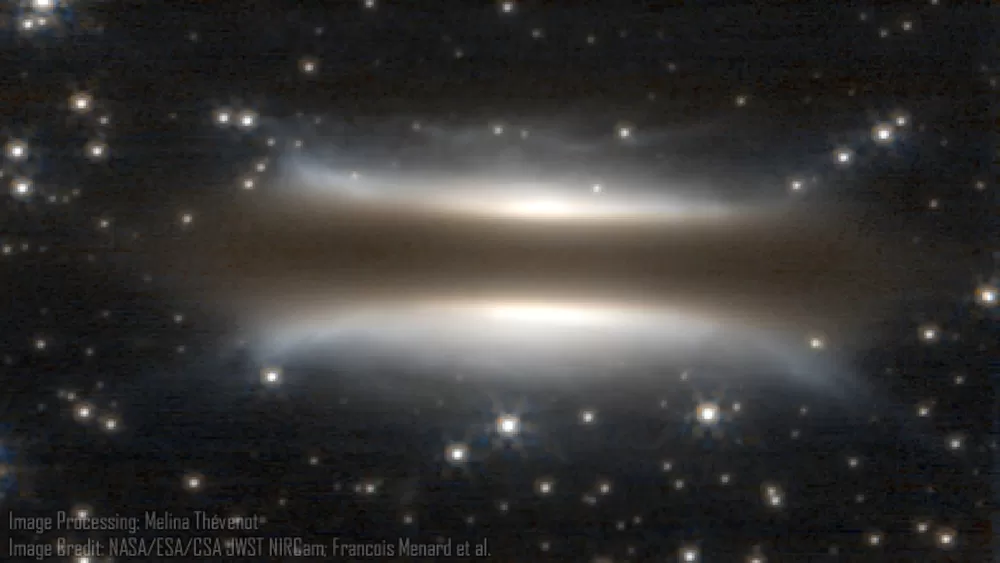
Gomez’s Hamburger offers an unprecedented peek at a newborn gas giant in the making
A massive, edge‑on protoplanetary disk nicknamed Gomez’s Hamburger lets astronomers watch dust and gas settle into a future gas giant, thanks to sharp images from JWST and ALMA.
When you hear the name “Gomez’s Hamburger,” you might picture a greasy bite from a fast‑food joint. In reality, it’s a sprawling, buttery‑smooth disk of dust and gas circling a newborn star about 453 light‑years away in the Scorpius‑Centaurus region of our Milky Way.
First spotted in 1985, the object was mistakenly catalogued as a distant planetary nebula—an error that persisted for decades. Only after the Atacama Large Millimeter/submillimeter Array (ALMA) tuned into its faint millimeter‑wave glow did scientists realize they were looking at something far more intriguing: a protoplanetary disk, nearly 93 billion miles across, tilted almost perfectly edge‑on to our line of sight.
That tilt is a gift. It lets us peel back the layers, watching the light from the star filter through the disk’s vertical structure. “GoHam gives us a rare and clear view of the vertical and radial structure of a very large, nearly edge‑on disk,” says Charles Law of the University of Minnesota, a co‑author of the new study published in The Astrophysical Journal.
ALMA’s keen eye captured the distribution of several molecular species. The lightest gas—carbon monoxide—floats up high above the disk’s midplane, while heavier, sulfur‑bearing molecules settle lower, as theory predicts. In the very heart of the disk, a thin band of millimeter‑sized dust clumps together, hinting that the building blocks of a future planet are already gathering.
But the picture isn’t perfectly symmetrical. The dust cloud leans north‑south, with the northern side glowing brighter and a bit wider. Astronomers suspect a vortex or some other disturbance is stirring the material, perhaps funneling extra dust into the region where a gas giant will soon emerge. Along the same northern edge, faint carbon monoxide trails suggest the central star is already blowing a gentle photoevaporative wind into space.
The sheer scale of the disk is staggering. At almost 93 billion miles (roughly 1,000 astronomical units) across, it dwarfs most protoplanetary disks we’ve observed. Its massive dust reservoir means it could spawn not just one, but an entire family of planets—maybe a handful of gas giants, a swarm of icy worlds, and everything in between.
Adding to the excitement, the James Webb Space Telescope provided a crisp near‑infrared view that beautifully outlines the silhouette of the disk against the glowing background of the nebula. The combination of JWST’s sharp imaging and ALMA’s molecular fingerprints offers, for the first time, a near‑complete 3‑D recipe of how a gas giant begins its life.
In short, Gomez’s Hamburger—despite its whimsical name—is proving to be a perfect laboratory for planet‑formation theory. Each new observation peels back another layer, bringing us closer to answering the age‑old question: how do the giant planets, like Jupiter and Saturn, actually form?
Editorial note: Nishadil may use AI assistance for news drafting and formatting. Readers can report issues from this page, and material corrections are reviewed under our editorial standards.