Students Storm Massachusetts State House Demanding AI Regulation
- Nishadil
- October 21, 2026
- 0 Comments
- 3 minutes read
- 9 Views
- Save
- Follow Topic
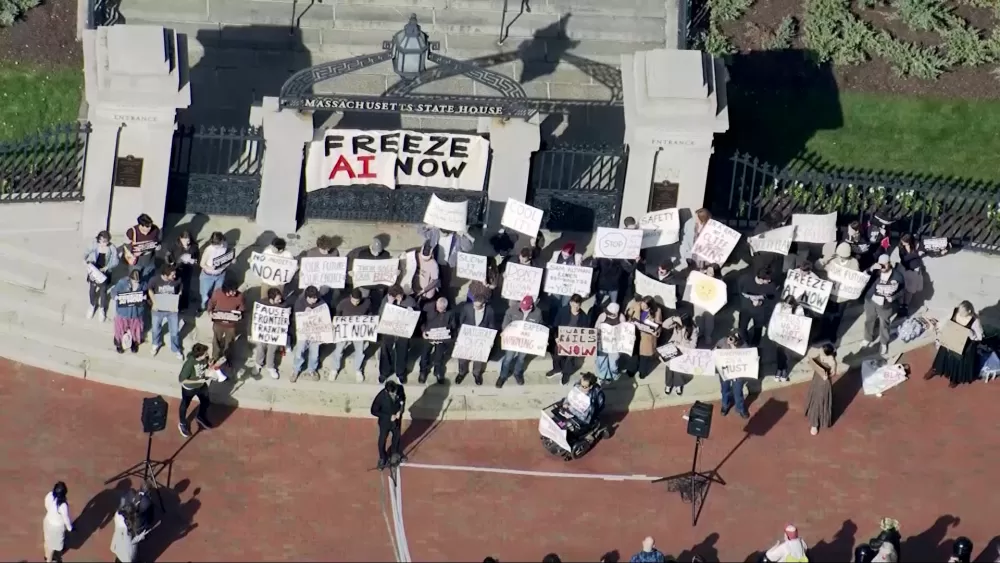
College activists block the State House to call for a pause on AI development and stricter oversight
Dozens of students gathered at Boston’s State House, urging lawmakers to freeze AI advances until clear privacy and safety rules are in place.
On a crisp Tuesday afternoon, a crowd of about a hundred students from several Boston-area colleges converged on the grand marble steps of the Massachusetts State House. They weren’t there for a campus rally or a sports pep‑talk – they were there to physically block the main entrance, a bold, noisy gesture meant to make lawmakers sit up and listen.
Holding homemade signs that read “Freeze AI” and “Our data, our future,” the demonstrators shouted a simple, repeated mantra: AI can’t keep sprinting ahead without rules to protect people’s privacy, jobs, and even lives. It was a message that felt both urgent and, in its own way, hopeful – hopeful that ordinary citizens could still shape the direction of a technology that now feels larger than any single nation.
Among the crowd was Alice Cai, a graduate student at MIT, who stepped up to the microphone and said, “I hope lawmakers see that people really care about this issue. We come from all walks of life, we don’t all agree politically, but when it comes to AI, we all want a say.” Her words captured a broader sentiment that rippled through the protest: the fear that massive AI profits are being chased at the expense of public safety and personal data.
The protest wasn’t an isolated flash mob. It’s part of a wave of student‑led actions spreading across the country, from campuses in California to schools in the Midwest. Organizers say they’re willing to risk grades, internships, and future job prospects just to make sure the conversation about AI regulation stays front‑and‑center.
Recent headlines have only stoked the fire. Last week, Anthropic, a leading AI firm, warned that its own models could soon operate with very little human oversight, potentially reaching into everyday gadgets like smart ovens and televisions. That kind of speculation makes the students’ call to “take a step back” feel even more pressing.
Looking at the Massachusetts Legislature’s website, you can find more than 250 entries for bills that touch on artificial intelligence – ranging from data‑privacy statutes to proposals for AI‑ethics review boards. Yet, critics argue that most of those proposals are still in limbo, and none yet spell out a clear, enforceable framework for how AI should be built, tested, and deployed.
As the sun set behind the historic dome, the protestors eventually cleared the doorway, but the echo of their chants lingered. Whether that echo turns into concrete legislation remains to be seen, but one thing is clear: a generation of students is no longer willing to sit on the sidelines while machines learn to make decisions that affect us all.
Editorial note: Nishadil may use AI assistance for news drafting and formatting. Readers can report issues from this page, and material corrections are reviewed under our editorial standards.