Stephen Hawking: From Classroom Wonder to Global Icon
- Nishadil
- November 08, 2026
- 0 Comments
- 4 minutes read
- 8 Views
- Save
- Follow Topic
How a British theoretical physicist became a household name
A quick look at Stephen Hawking’s life— from a bright schoolboy in wartime England to a world‑famous scientist whose wheelchair and voice made complex ideas feel personal.
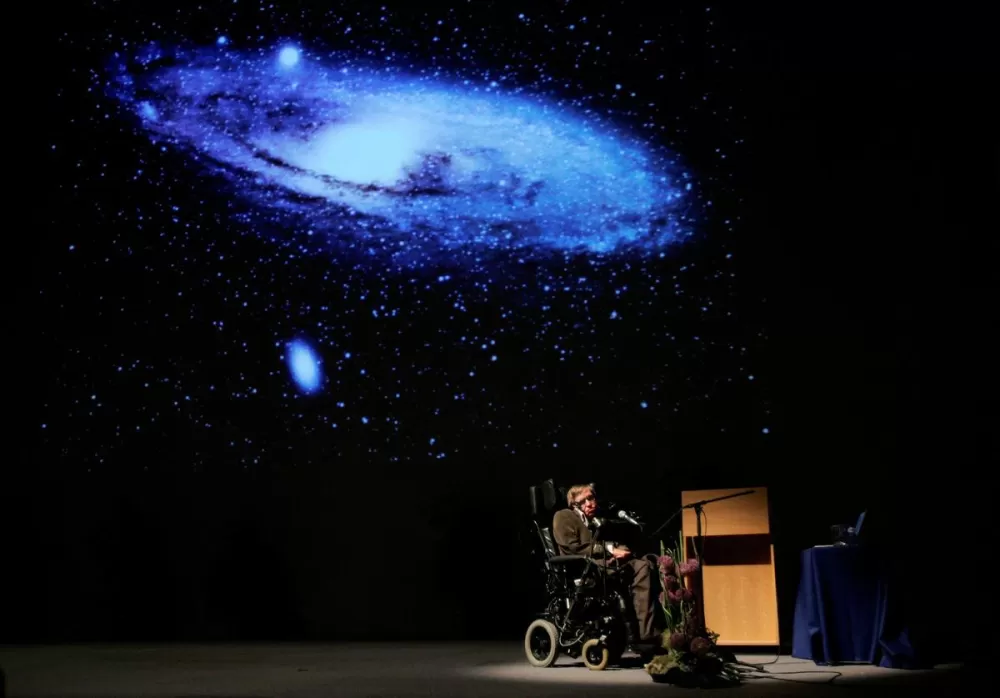
If you hear the name Stephen Hawking, the first image that pops up is often that of a man in a wheelchair, his eyes hidden behind a pair of round spectacles, speaking in a robotic voice. It’s a picture that’s been reproduced countless times, on TV, in movies, even on souvenir mugs. Yet for the first quarter of his life, Hawking moved about like any other teenager— no wheelchair, no famous voice‑synthesiser, just a curious kid with a notebook.
Born on 8 January 1942, in the midst of World War II, Stephen was the eldest of four children in a modest family from St Albans, England. He wasn’t the sort of prodigy who wowed teachers with pre‑calculus at age six. In fact, his early school reports described him as “average” and “quiet.” It was only later, when he reached university, that the spark truly ignited.
At 17, Hawking slipped into University College, Oxford, to study physics. He was, by his own admission, more interested in the social scene than the lecture hall. Still, the very act of being surrounded by brilliant minds nudged him toward deeper questions about the universe. After Oxford, he pursued a doctorate at Cambridge, where a chance meeting with Roger Penrose introduced him to the baffling world of black holes.
It was at Cambridge that fate took a cruel turn. In 1963, at the age of 21, Hawking was diagnosed with a rare form of motor‑neurone disease— later known as amyotrophic lateral sclerosis (ALS). Doctors gave him a grim prognosis: just a few years to live. The news could have crushed many, but Hawking’s mind kept racing. He began to weave together general relativity and quantum mechanics, asking a daring question: what happens to information when it falls into a black hole?
The answer, published in 1974, shook the physics community. Hawking showed that black holes are not completely black; they emit faint radiation— now called Hawking radiation. This discovery linked the physics of the very large (Einstein’s relativity) with the very small (quantum theory), a holy grail for theorists. Suddenly, a scientist who once went unnoticed was being cited in journals across the world.
What made Hawking a celebrity, though, was his uncanny ability to translate mind‑bending concepts into stories anyone could follow. His 1988 bestseller, A Brief History of Time, sold millions of copies, perched on coffee tables in homes far from any university. He appeared on talk shows, participated in comedy sketches, and even lent his voice to a cameo in The Simpsons. The public loved the juxtaposition: a brilliant mind trapped in a fragile body, still cracking jokes about the cosmos.
Over the decades, Hawking’s wheelchair became more than a medical device; it turned into a symbol of resilience. In 2018, a wheel‑chair he used in the early 1970s fetched nearly £300,000 at auction, while his original doctoral thesis fetched close to £585,000. Those numbers are less about money and more about how deeply his story resonated with people.
Beyond the limelight, Hawking continued to push scientific boundaries. He co‑authored papers on cosmology, proposed the “no‑boundary” condition for the universe, and even debated the existence of extraterrestrial life. He never let his physical limitations stop him from attending conferences, signing books, or even taking a zero‑gravity flight in 2007.
When Stephen Hawking passed away on 14 March 2018, the world mourned not just a scientist, but a cultural touchstone. Tributes poured in from presidents, pop stars, and ordinary fans who felt they’d shared a tiny piece of the universe through his words.
Today, his legacy lives on in classrooms, in popular culture, and in the very equations that attempt to unify physics. The man who once struggled to climb stairs now walks forever in the minds of anyone who ever looked up at the night sky and wondered.
Editorial note: Nishadil may use AI assistance for news drafting and formatting. Readers can report issues from this page, and material corrections are reviewed under our editorial standards.