Scientists Stitch Photonic Qubits Together Without Killing the Light
- Nishadil
- October 11, 2026
- 0 Comments
- 2 minutes read
- 24 Views
- Save
- Follow Topic
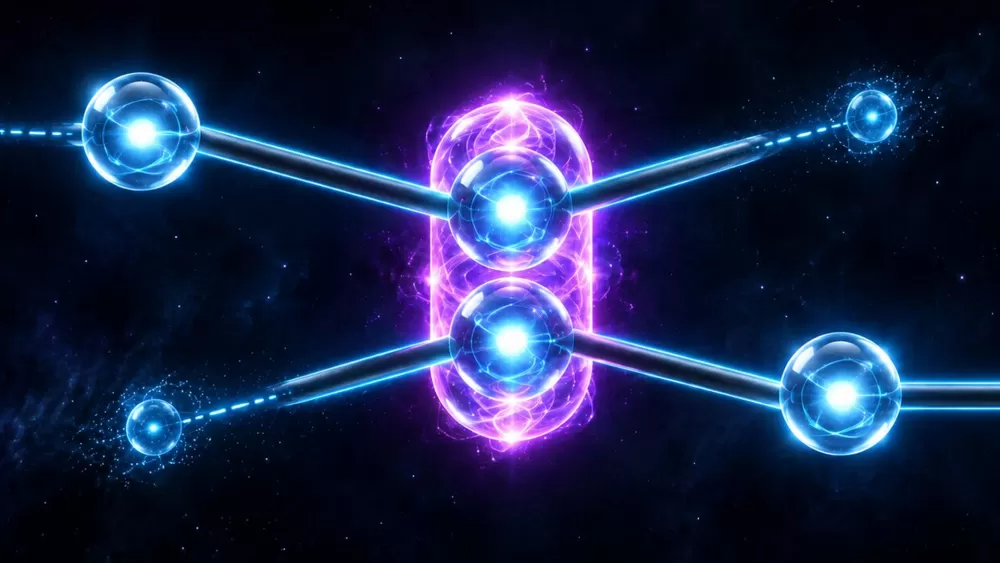
13‑qubit genuine entanglement realized via nondestructive fusion of microwave photons
Researchers in China have shown that smaller groups of entangled microwave photons can be merged into a larger, programmable network without destroying the photons, achieving genuine entanglement across 13 qubits.
Quantum computers promise to solve problems that make today’s super‑computers look like calculators, yet getting a handful of qubits to work together is already a nightmare. The real hurdle is scaling – joining many qubits into a coherent, controllable whole.
In a recent paper published in Nature Physics, a team from Tsinghua University and collaborators demonstrated a clever workaround. Instead of trying to create one gigantic entangled state in a single go, they built it piece by piece, fusing tiny clusters of microwave photons while keeping the photons intact.
How do you join photons without gobbling them up? The answer lies in a technique called quantum nondemolition (QND) measurement. Unlike ordinary measurements that absorb a photon, a QND measurement peeks at the system’s state and leaves the photon untouched. The researchers paired this with a superconducting circuit that both generated the photons and acted as a detector.
First, the team generated small entangled groups – think of them as LEGO bricks made of photons. Each brick encoded information in distinct time slots, so the photons arrived like a carefully timed train. Then, by applying the QND detector to selected pairs, they projected those pairs into a Bell state. In plain English: the two photons became tightly linked without being destroyed, allowing the bricks to snap together.
What’s really neat is that the whole process is programmable. By tuning the frequencies of the photons, the scientists could choose exactly which pairs to fuse, shaping the larger graph state at will. They also added active reset of the superconducting qubits and built‑in error mitigation to keep decoherence – the inevitable loss of quantum‑ness – in check.
The end result? Genuine multipartite entanglement spanning 13 photonic qubits. That’s more than just a handful of isolated entangled pairs; it’s a single, sprawling quantum web that could serve as a resource for measurement‑based quantum computing, quantum networking, and even error‑correction schemes.
Of course, a 13‑qubit demo isn’t a full‑blown quantum computer yet. The apparatus still needs better photon‑generation efficiency, higher‑fidelity detectors, and tighter control over errors. The authors say the next step is to roll out multi‑detector architectures that can handle many fusions in parallel, inching closer to truly scalable photonic quantum processors.
Even if the road ahead is long, this work shows that deterministic, nondestructive fusion is possible – a promising stride toward the dream of large‑scale, reconfigurable quantum networks.
Editorial note: Nishadil may use AI assistance for news drafting and formatting. Readers can report issues from this page, and material corrections are reviewed under our editorial standards.