Non‑Flammable Polymer Membrane Boosts Fluoride‑Ion Batteries
- Nishadil
- November 07, 2026
- 0 Comments
- 2 minutes read
- 2 Views
- Save
- Follow Topic
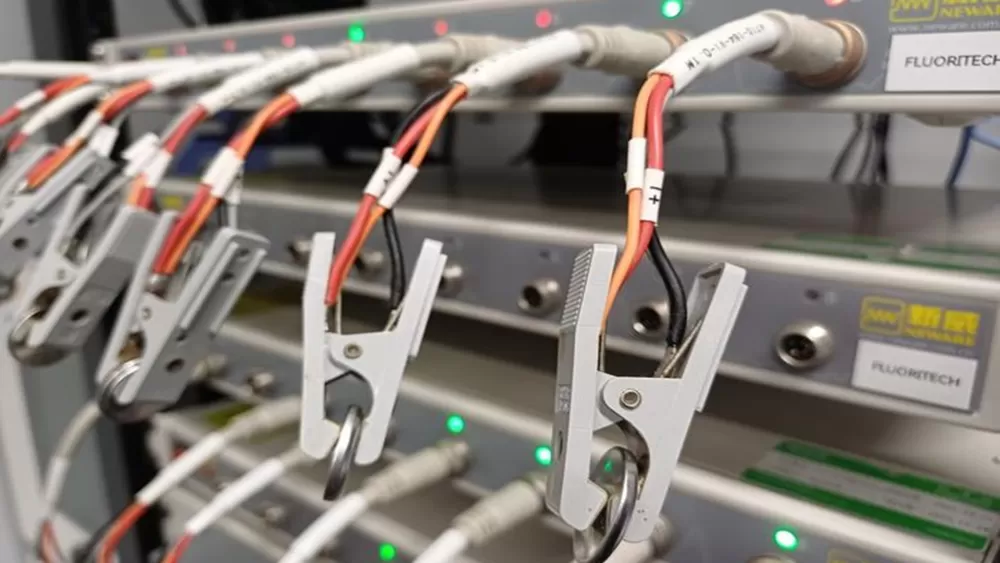
A quasi‑solid gel lets fluoride ions move at room temperature, pushing prototype cells past 50 cycles
Italian scientists unveil a polymer membrane that conducts fluoride ions without fire risk, achieving 1.3 mS cm⁻¹ conductivity and stable cycling over 50 rounds.
Imagine a battery that doesn’t rely on lithium at all. Sounds like science‑fiction, right? Yet a team at Politecnico di Milano has just taken a solid step toward that vision by inventing a polymer membrane that shuttles fluoride ions at ordinary, room‑temperature conditions.
The trick lies in a quasi‑solid gel—essentially a polymer‑based electrolyte that’s soft enough to let ions slip through, yet sturdy enough to stay put. By blending two solvents, 1,3‑dioxolane and dimethyl sulfoxide, the researchers got the polymer to swell just right, opening tiny pathways for the fluoride ions.
What’s impressive is the numbers. Electrochemical impedance spectroscopy showed the membrane could reach an ionic conductivity of about 1.3 × 10⁻³ S cm⁻¹, which, for a fluoride‑ion conductor working at room temperature, is practically a breakthrough. It’s the kind of conductivity you usually only see in high‑temperature or liquid electrolytes.
To see if it actually works in a battery, the team built coin‑cell prototypes using lead and lead‑fluoride electrodes. The cells showed reversible fluorination and defluorination – in plain English, the fluoride ions moved in and out of the electrodes as the battery charged and discharged.
And they didn’t just survive a single cycle. The cells kept going for more than 50 cycles at a modest 0.1 C rate, all without any sign of the membrane catching fire. That non‑flammability is a pleasant safety bonus, especially when you compare it to the flammable liquid electrolytes used in many lithium‑ion designs.
Of course, we’re still a ways off from seeing a commercial fluoride‑ion battery cruising down the highway. The electrode materials still need work, the long‑term stability has to be proven, and scaling up from a tiny coin cell to a full‑size pack is never trivial. But the researchers are optimistic – they see a theoretical energy density near 600 Wh kg⁻¹, which dwarfs the 150‑250 Wh kg⁻¹ you get from today’s lithium‑ion cells.
The study, published in Energy Storage Materials, was coordinated by Maurizio Sansotera, with Luca Magagnin handling the electrochemical tests and Giuseppina Raffaini running the molecular‑dynamics simulations that highlighted the role of DMSO as a polar swelling agent.
All in all, this polymer membrane could be the missing link that finally lets fluoride‑ion chemistry operate at room temperature, bringing us a step closer to safer, higher‑energy batteries that don’t depend on lithium.
Editorial note: Nishadil may use AI assistance for news drafting and formatting. Readers can report issues from this page, and material corrections are reviewed under our editorial standards.