Japan’s Bold Leap: Sending a Robot to Mars’s Moon Phobos
- Nishadil
- October 20, 2026
- 0 Comments
- 3 minutes read
- 7 Views
- Save
- Follow Topic
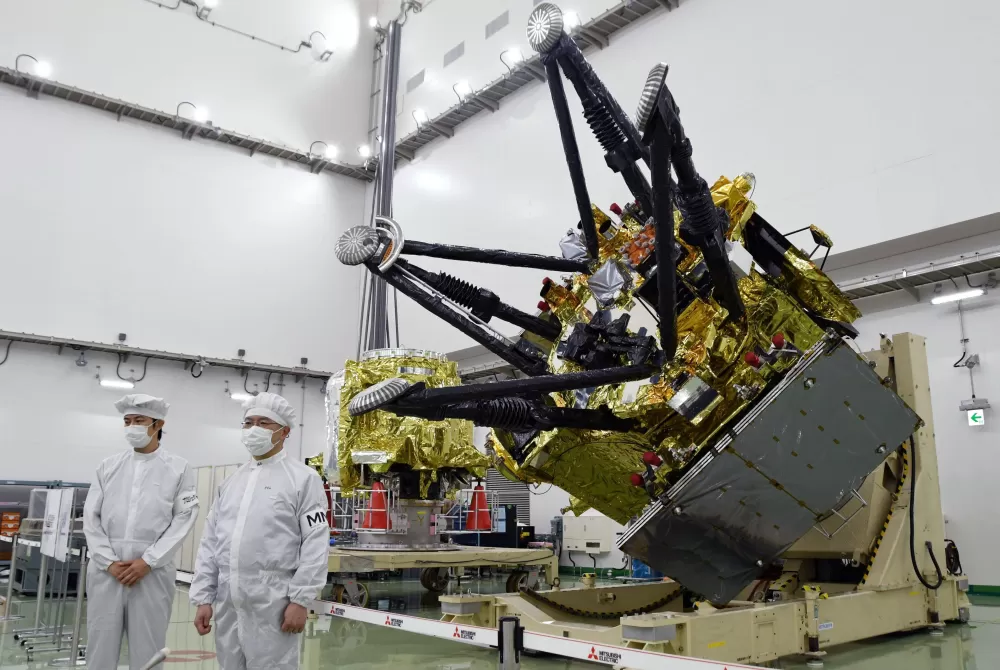
Japan launches $350 million MMX mission to explore Phobos and bring back samples by 2031
A Japanese H3 rocket lifted off, carrying the MMX spacecraft that will land a tiny rover on Phobos, study both Martian moons and return rock fragments to Earth.
On a crisp Monday afternoon, a Japanese H3 rocket roared to life at Tanegashima Space Center, marking the start of a $350 million adventure that most of us only see in sci‑fi movies. The payload? The Martian Moons Exploration (MMX) probe, a 9,900‑pound spacecraft bound for the red planet’s tiny companions – Phobos and Deimos.
Why bother with those pebble‑sized moons? Scientists are still debating whether Phobos and Deimos are wayward asteroids that Mars captured eons ago, or the scarred leftovers of a colossal impact that once battered the planet. The answer could rewrite our picture of how the inner solar system formed.
MMX’s game plan is ambitious. After a year‑long trek, the craft will swing into orbit around Mars in September 2027, matching its path with Phobos. For the next three years it will act like a high‑tech tourist, circling the moon, peering at its surface with a suite of spectrometers, cameras and laser‑based instruments, and even testing whether the rock could serve as a future base for astronauts.
The star of the show is a feather‑light 55‑pound rover, built jointly by German and French space agencies. It has no rockets for a gentle touchdown – Phobos’s gravity is a mere 0.001 g, so the rover will simply bounce, tumble, and come to rest. Designed to right itself, it will then crawl around, snapping photos, firing laser beams into the soil and measuring temperature, all while sending data back to Earth.
About a year after the rover lands, MMX itself will make a daring move: it will touch down on Phobos – possibly twice – using two different sample‑collecting devices, one from JAXA and another from NASA. The mission aims to snag at least 10 grams of material, enough to run a battery of laboratory tests but still a feather‑weight by Earth standards.
Once the samples are secured, the spacecraft will head back toward Mars, swing past Deimos for a quick glance, and then set a course for home. A heat‑shielded capsule will streak through Earth’s atmosphere, aiming for a recovery zone in Australia where a waiting team will pry it open. Researchers worldwide will then pore over the ancient rocks, hoping to finally answer whether Phobos is a captured asteroid or the remnants of a Mars‑sized impact.
“There’s a lot of adrenaline, a lot of excitement, and a lot of wow,” says Thomas Statler, who helped design two of the instruments. “Watching that capsule re‑enter and opening it for the first time – that’s the moment we’ve all been dreaming about.”
- UnitedStatesOfAmerica
- News
- Space
- NASA
- Science
- ScienceNews
- Astronomy
- Japan
- SpaceExploration
- Mars
- PlanetaryScience
- Jaxa
- ScienceTech
- Asteroids
- SpaceAndAstronomy
- SampleReturn
- Phobos
- SpacecraftLaunch
- MmxMission
- RoboticSpacecraft
- RoboticRover
- ThomasStatler
- Deimos
- MoonsOfMars
- MartianMoons
- MarsMoonExploration
Editorial note: Nishadil may use AI assistance for news drafting and formatting. Readers can report issues from this page, and material corrections are reviewed under our editorial standards.