Fusion's Next Frontier: Innovating Exhaust Systems to Bring Star Power to Earth
- Nishadil
- October 19, 2026
- 0 Comments
- 5 minutes read
- 10 Views
- Save
- Follow Topic
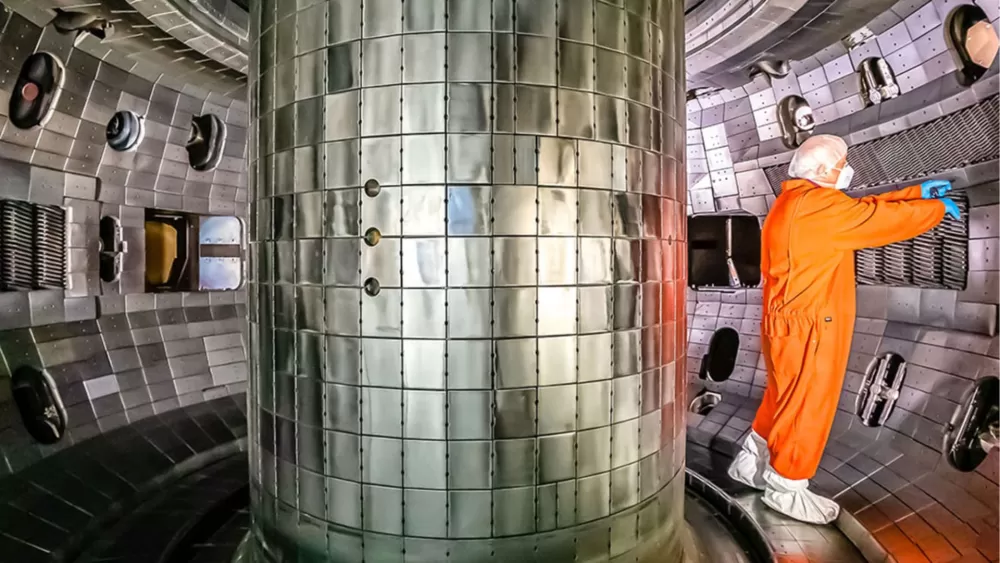
Taming the Tokamak's Tail: Scientists Discover New Ways to Manage Fusion's Exhaust Heat
Scientists are making exciting strides in managing the intense heat and complex gases expelled from nuclear fusion reactors. From a surprising plasma escape mechanism to innovative divertor designs and sophisticated gas processing, these efforts are crucial for realizing the dream of limitless clean energy.
For decades, the tantalizing promise of nuclear fusion—the very process that powers our sun—has captivated scientists and dreamers alike. Imagine a world with virtually limitless, clean energy, free from the emissions and waste associated with traditional power sources. It's a vision that inspires incredible ingenuity, but bringing a miniature star down to Earth, even in a controlled environment like a tokamak reactor, comes with its own unique and rather daunting challenges. One of the biggest hurdles? Figuring out what to do with the intense, superheated exhaust.
But here's some genuinely exciting news, straight out of the U.S. Department of Energy's Princeton Plasma Physics Laboratory (PPPL). Recent research, published just this past June, offers a significant sigh of relief regarding one aspect of this fiery challenge. Scientists, led by the brilliant Choongseok Chang, have uncovered a brand-new mechanism for how plasma escapes the reactor core. What they found suggests that the exhaust heat, in future commercial-scale fusion reactors, might actually be less destructive than we previously thought. Think of it this way: instead of a concentrated laser beam of heat scorching a tiny spot, the escaping particles appear to spread out, colliding with a much larger area of the vessel. Simulations indicated that electrons, in particular, widen this heat strike zone by a remarkable 30%.
This is huge because for a long time, the prevailing worry was that this exhaust heat would focus like a magnifying glass onto a very narrow band of what are called divertor plates. These plates are crucial components, tasked with drawing away both heat and impurities from the plasma, kind of like the exhaust pipe on a car, but for plasma! So, this discovery that the heat naturally disperses more broadly? It potentially mitigates a major risk factor, especially for those more compact reactor designs where space is at a premium. Still, let's be clear: power exhaust remains a complex and vital puzzle piece in the fusion quest.
Of course, this isn't the only ingenious approach being explored to manage fusion's fiery breath. Across the pond, the UK's MAST Upgrade experiment, which has been operational since 2021, is actively testing advanced power-exhaust concepts. Their "Super-X divertor" (SXD), for instance, has already demonstrated the potential for an astounding tenfold or even greater reduction in heat flux—talk about effective! And here in the U.S., down at MIT, researchers unveiled an innovative solution back in 2018. Led by Adam Kuang and Professor Dennis Whyte, their design for compact fusion reactors uses cutting-edge high-temperature superconducting magnets to create a longer and wider "exhaust pipe" (another type of divertor) for much more efficient heat shedding. Different problems, different brilliant solutions, all aimed at the same goal.
Even more specifically, facilities like the DIII-D fusion facility in the US are actively experimenting with custom exhaust systems, exploring things like "reverse-D plasma shapes" to fine-tune heat management. It’s all part of the continuous, hands-on experimentation. But the challenge of fusion exhaust isn't just about heat; it's also about what's in the exhaust. Imagine all those fusion reaction products and unburnt fuel. You can't just vent it; it needs to be carefully processed and recycled. This brings us to another critical piece of the puzzle: gas processing.
Enter the Tokamak Exhaust Processing (TEP) system for ITER, the massive international experimental fusion reactor currently under construction. The United States has taken on a substantial role here, being responsible for the design, fabrication, and ultimate delivery of this incredibly complex chemical processing system. Its purpose? To manage the crucial deuterium-tritium fusion fuel cycle. Think of TEP as a sophisticated recycling plant for the reactor's "smoke." It meticulously separates the exhaust gases into a pure stream of hydrogen isotopes—the valuable fuel—and a separate, hydrogen-free gas stream containing impurities. The Savannah River National Laboratory (SRNL), leveraging its deep expertise in tritium technology, is leading this charge, working hand-in-hand with US ITER and PPPL. The first phase of TEP's final design was just wrapped up in late 2022, marking another steady step forward.
From brilliant discoveries about plasma behavior to ingenious engineering designs for heat management, and from complex chemical processing plants for fuel recycling to continuous, hands-on experimentation, the global scientific community is leaving no stone unturned in its quest for practical fusion energy. Each breakthrough, each innovative design, and each successful test brings us incrementally closer to harnessing the power of the stars right here on Earth, offering a cleaner, brighter energy future for generations to come. It’s a marathon, not a sprint, but the progress is undeniable and truly inspiring.
Editorial note: Nishadil may use AI assistance for news drafting and formatting. Readers can report issues from this page, and material corrections are reviewed under our editorial standards.