Aurora Supercomputer Powers Record‑Breaking Cosmic Simulations
- Nishadil
- October 21, 2026
- 0 Comments
- 5 minutes read
- 10 Views
- Save
- Follow Topic
Argonne’s exascale machine runs two 13‑trillion‑particle simulations to probe the universe’s first moments
Using about 50,000 GPUs, the Aurora supercomputer at Argonne National Laboratory completed two of the biggest cosmology runs ever, modeling dark‑matter across 28.6 billion light‑years to test ideas about cosmic inflation.
When you hear the word “exascale,” you might picture a futuristic data‑center humming with the power of a small galaxy. In reality, that’s exactly what Argonne National Laboratory built with Aurora – a monster of a supercomputer that crammed roughly 50,000 graphics processors into 8,100 compute nodes.
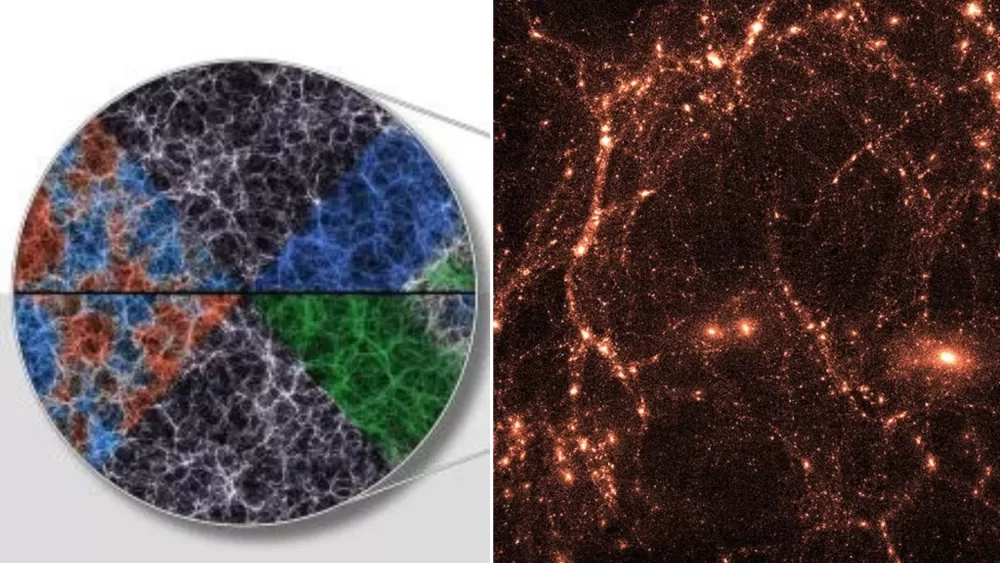
Last month, a team led by computational scientist Nicholas Frontiere put Aurora to the test. Over a span of just four days, they ran two colossal simulations, each tracking 13.4 trillion dark‑matter particles across a stretch of space that would span 28.6 billion light‑years if you could lay a ruler across it. That’s the size of the observable universe, give or take a few megaparsecs.
Why go to such extremes? The goal was to peek behind the veil of cosmic inflation – that hypothesized flash of expansion right after the Big Bang. Inflation stretched quantum jitters into the seeds of galaxies, but we still don’t know what physics drove the burst. By simulating those early ripples with unprecedented detail, researchers hope to spot tiny fingerprints – so‑called primordial non‑Gaussianities – that could separate competing theories.
Dark matter doesn’t shine, so you can’t photograph it directly. Instead, scientists treat it like an invisible scaffolding: massive particles whose gravity pulls on everything else. In the Aurora runs, each particle represented a packet of dark‑matter density and velocity, letting the code watch how gravity coaxed the cosmic web into shape over billions of years.
One of the trickier bits is dealing with “cosmic variance,” the statistical fuzz that shows up when you only observe a slice of the whole sky. To tame that, the Argonne team ran two simulations that were identical except for a flip in their initial random phases. Analyzing both together helps cancel out random noise, making any genuine signal stand out louder.
Aurora’s raw horsepower was essential. The machine houses 10,624 nodes and a staggering 63,744 GPUs, plus a massive memory and storage fabric. During the runs, more than 85 petabytes of checkpoint data streamed through Aurora’s Distributed Asynchronous Object Storage system – essentially a safety net that lets a calculation pick up where it left off if something hiccups. After pruning, about 8 petabytes remained for scientific digging.
The simulations were powered by Argonne’s HACC (Hardware/Hybrid Accelerated Cosmology Code), a flexible framework that can run on a variety of supercomputing architectures. Unlike earlier efforts on Oak Ridge’s Frontier system, which mixed gravity with gas dynamics and star formation, these Aurora experiments focused solely on gravity. That narrowed scope let the team push the volume and particle count even higher.
What’s the payoff? The synthetic sky maps that emerge will act as a rehearsal for upcoming surveys like the Dark Energy Spectroscopic Instrument (DESI) and NASA’s SPHEREx mission. By feeding the same analysis pipelines that will later be used on real observations, scientists can spot biases, calibrate methods, and boost confidence that any subtle, early‑universe signals they eventually find are real and not artifacts.
The work was made possible by the Department of Energy’s Innovative and Novel Computational Impact on Theory and Experiment (INCITE) program, which grants precious super‑computing time to projects that need it most. As the next generation of telescopes starts delivering torrents of data, having a virtual universe of this scale will be like having a massive laboratory on a screen – one where you can tweak the laws of physics and watch what happens.
In short, Aurora proved that when you pair raw GPU muscle with clever code, you can recreate a slice of the cosmos large enough to ask the big questions and fine‑grained enough to hear the whisper of inflation’s secrets.
Editorial note: Nishadil may use AI assistance for news drafting and formatting. Readers can report issues from this page, and material corrections are reviewed under our editorial standards.