A 3‑D Peek Inside Orion’s Stellar Nursery Reveals Twisting Chemistry
- Nishadil
- October 20, 2026
- 0 Comments
- 4 minutes read
- 14 Views
- Save
- Follow Topic
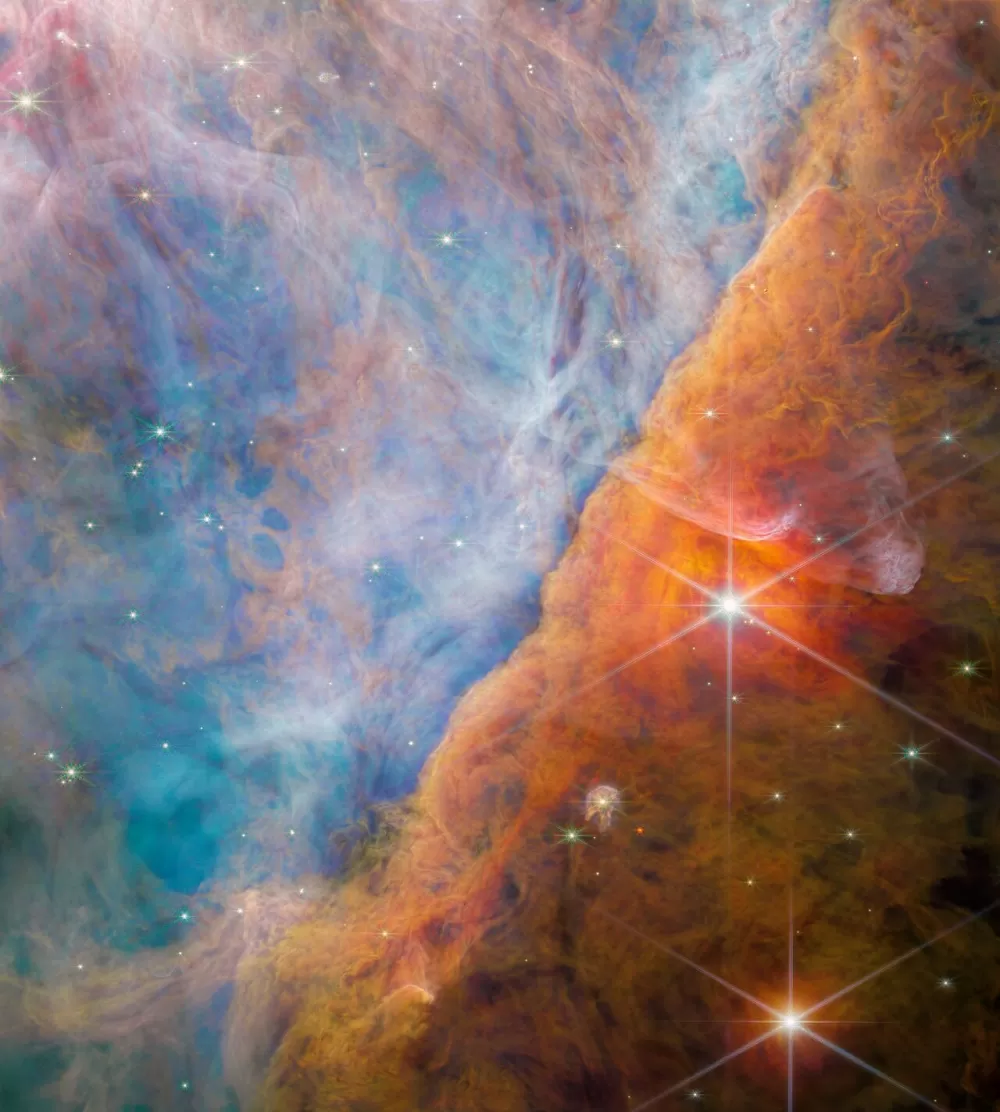
New three‑dimensional model shows how overlapping chemical fronts reshape the Orion Bar
Astronomers have built the first fully 3‑D high‑resolution simulation of the Orion Bar, exposing how molecular hydrogen and ionised carbon coexist and drive unexpected chemistry in star‑forming clouds.
When you look up at the Orion Nebula, you’re really gazing at a bustling cosmic workshop. Within that bright haze lies the Orion Bar – a long, ribbon‑like ridge of gas and dust that has long served as a textbook example of a photodissociation region, or PDR. For decades scientists thought of it as a series of neatly stacked layers: first ionised gas, then a thin atomic shell, and finally the cold molecular heart where stars are born.
That tidy picture started to crumble once the Atacama Large Millimeter/submillimeter Array (ALMA) and the James Webb Space Telescope (JWST) turned their eyes toward the Bar. Their razor‑sharp eyes revealed that the front where molecular hydrogen (H₂) is ripped apart by starlight actually overlaps with the front where ionised carbon (C⁺) recombines into neutral carbon. In other words, the layers are smeared together, not neatly separated.
Enter Dr. Brandt Gaches and his team from the University of Duisburg‑Essen. In a paper titled “Resolving dense photodissociation regions: The structure of photochemical fronts in three‑dimensional gas distributions” (Astronomy & Astrophysics, 2026), they set out to see whether a realistic 3‑D model could reproduce this messy reality.
“The Orion Bar is an ideal natural laboratory,” Gaches said in a press release. “We see it almost edge‑on, so the different chemical layers are laid out in front of us like a slice of a cake.” The team took advantage of that favourable angle, combined it with the new JWST and ALMA data, and built the first fully three‑dimensional, high‑resolution simulation of an Orion‑Bar‑like region.
The model does more than just draw pretty pictures. By mapping out the density of the gas in three dimensions, it shows how dense clumps cast shadows, shielding pockets of material from the intense ultraviolet glare of newborn stars. Those shadows become safe harbours where H₂ can survive, while nearby zones are bathed in enough energy to keep carbon ionised. The result? A tangled web where H₂ and C⁺ coexist, opening up what astrochemists call “excited‑state hydrocarbon chemistry.” In that regime, reactions that are normally forbidden get a free pass, spawning molecules such as methane, acetylene and even complex polycyclic aromatic hydrocarbons (PAHs) – the building blocks of more elaborate organic chemistry.
Visually, the simulation is striking. Red ribbons mark the H₂ dissociation front, cyan bands trace the C⁺ recombination front, and where they intersect you can see the chaotic filaments and arcs that JWST actually captured in infrared light. The model reproduces those filamentary structures without any hand‑tuning – a strong hint that the physics baked into the simulation is on the right track.
Why does this matter? For a long time, astronomers have relied on one‑dimensional models that assume a simple stack of layers. Those models can’t capture the overlapping fronts we now see in the Orion Bar, so they fall short when trying to predict the exact emission signatures astronomers detect at infrared and radio wavelengths. By moving to a three‑dimensional framework, researchers can now explain why certain spectral lines appear where they do, and why some regions glow brighter than theory previously allowed.
The implications stretch beyond Orion. Giant Molecular Clouds (GMCs) across the Milky Way – the massive, cold reservoirs of H₂ where new stars are born – are riddled with similar PDRs. If the Orion Bar is any guide, the complex interplay of radiation, shadowing, and chemistry likely shapes the fate of many star‑forming regions.
Gaches and his collaborators are quick to point out that they didn’t set out to perfectly fit every observation. Their goal was to test whether a realistic 3‑D chemistry code could even approach the observed morphology. The fact that it did – reproducing arcs, filaments and the overlapping fronts – is a triumph that, in their words, “marks a turning point for astrochemistry.”
Looking ahead, the team hopes to plug in different physical drivers – like magnetic fields or stellar winds – and watch how the chemistry reshapes in response. In short, we’re finally getting a true three‑dimensional view of the messy, beautiful chemistry that governs how stars, planets and possibly life‑bearing molecules emerge from clouds of gas and dust.
Editorial note: Nishadil may use AI assistance for news drafting and formatting. Readers can report issues from this page, and material corrections are reviewed under our editorial standards.