Unveiling a Hidden History: Professor Lew-Williams on Chinese Discrimination in America
- Nishadil
- October 16, 2026
- 0 Comments
- 4 minutes read
- 6 Views
- Save
- Follow Topic
Beyond the Acts: Professor Beth Lew-Williams Illuminates the Deeper Realities of Chinese Discrimination in the US
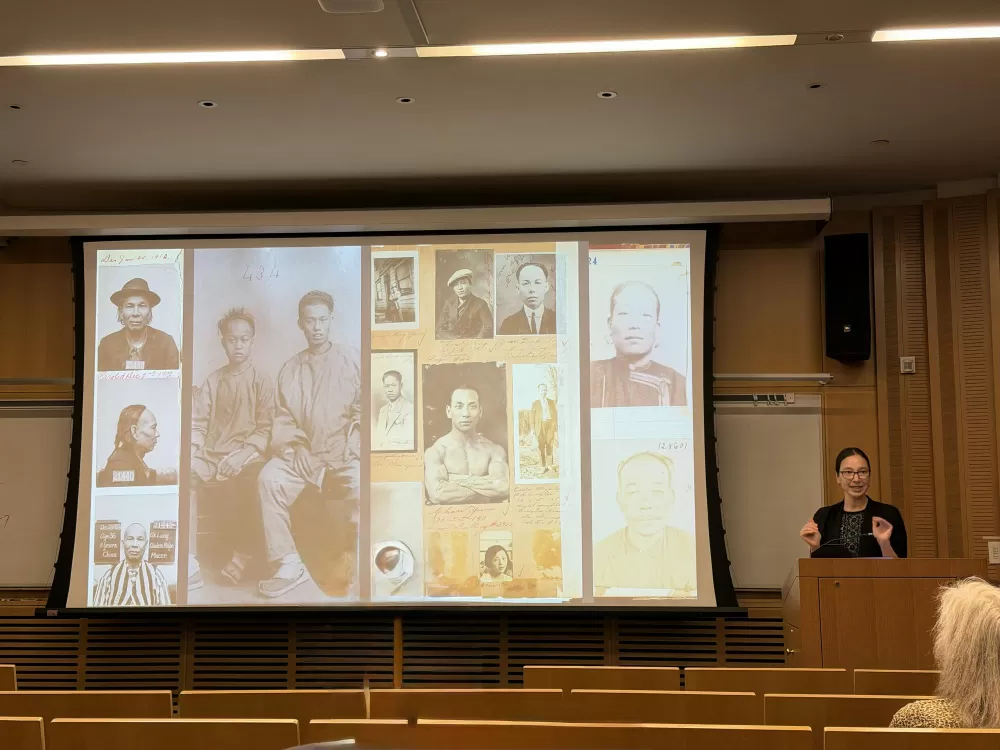
Professor Beth Lew-Williams of Princeton University recently delivered a powerful Stulman Lecture at Johns Hopkins, delving into the nuanced and often brutal history of Chinese racial discrimination in the United States, extending beyond legislative acts to explore the everyday realities and systemic violence faced by Chinese immigrants through property and societal structures.
It's easy, perhaps too easy, to view history through the lens of major legislative acts and landmark events. We learn about the Chinese Exclusion Act, for instance, and think we understand the story. But what if I told you that the true narrative of Chinese racial discrimination in the United States runs far deeper, woven into the very fabric of daily life, language, and even the ownership of land? That's precisely the profound insight Professor Beth Lew-Williams from Princeton University offered during her compelling Stulman Lecture at Johns Hopkins University on October 8, 2026.
Lew-Williams challenged her audience to look beyond the often-cited laws, arguing passionately that "Chinese Exclusion was not just law; it was also a way of life." This isn't just academic; it's deeply human. Her research meticulously uncovers how discrimination was enforced not merely by government decrees but by a pervasive culture of hostility and everyday acts of marginalization. It was, she explained, a calculated effort to define who truly 'belonged' in America, and, unfortunately, who didn't. This systemic effort used what she termed the "politics of belonging" to exclude Chinese individuals from society's mainstream, pushing them to the fringes in ways we might not immediately recognize.
Think about the sheer power of a word, a single term, to dehumanize and denigrate. Lew-Williams brought to light the devastating impact of the epithet "Chinaman," which, during the 19th century, wasn't just a casual slur. It was a loaded term, strategically deployed to strip Chinese immigrants of their dignity and justify their inferior treatment. This wasn't just name-calling; it was a deliberate, linguistic weapon designed to foster and cement a narrative of otherness, making violence and discrimination seem, to some, almost acceptable.
The ugly truth is that this discrimination manifested itself in incredibly tangible ways, especially concerning property and space. Imagine being burned out of your home, as happened to Chinese communities in Truckee, California, in 1878. Or consider a legally binding lease, like one from Ventura County in 1886, explicitly prohibiting the sale or lease of property to Chinese individuals. Lew-Williams showcased how "the power of ordinary objects" – deeds, leases, and property lines – became instruments of exclusion. Even housing covenants, often unseen today, dictated where people could live, creating segregated areas like the Rose City District and ensuring that even the very ground beneath their feet was denied to many.
And just when you think it couldn't get worse, these everyday acts of prejudice often found reinforcement in official channels. While the lecture highlighted the pervasive nature of everyday discrimination, it didn't shy away from the legislative framework that supported it. Acts like the Geary Act of 1892, an extension of the broader Chinese Exclusion Acts, further solidified the legal barriers. This wasn't just local prejudice; it had the insidious backing of federal power, creating a system that was incredibly difficult, if not impossible, to navigate for those targeted.
The insights offered by Professor Lew-Williams, whose work was praised by attendees like Hannah Postel, an Assistant Professor of Public Policy at Duke University, and Jasmin Mendoza-Aragon, a second-year History and Latin Studies student at JHU, serve as a vital reminder. Her meticulous historical excavation, diving deep into archives from California and beyond, forces us to confront uncomfortable truths about our past. It's a stark, yet necessary, reminder that discrimination isn't always overt; sometimes, it's quietly embedded in societal structures, in language, and in the very spaces we inhabit. Understanding this complex, human story is crucial for truly grasping the fabric of American history and, perhaps, for building a more inclusive future.
Editorial note: Nishadil may use AI assistance for news drafting and formatting. Readers can report issues from this page, and material corrections are reviewed under our editorial standards.