The Next Frontier: Robots That Move and Learn With Uncanny Human-Like Grace
- Nishadil
- November 17, 2026
- 0 Comments
- 6 minutes read
- 12 Views
- Save
- Follow Topic
From Piano Prodigies to Expressive Eyes: How New AI & Robotic Muscles Are Redefining the Future
Groundbreaking research from the University of Pennsylvania and USC Viterbi School of Engineering is unveiling artificial muscles for incredibly nuanced robotic movements and AI systems that learn complex tasks, like playing the piano, with startling speed and autonomy.
For what feels like ages, robots in our collective imagination, and indeed in many real-world applications, have been defined by their somewhat rigid, often clunky movements. We've seen them perform incredible feats of precision and strength, yes, but often lacking that organic fluidity we associate with living beings. Well, that might just be changing, and quite rapidly too, thanks to some truly fascinating advancements happening right now in research labs across the United States. We're talking about robots that are starting to move, and even learn, in ways that feel... dare I say, almost human.
One major hurdle in creating truly lifelike robots has always been their inability to mimic the subtle, intricate movements of our own bodies – think of the delicate precision of a surgeon's hand or the nuanced expression in a glance. It's a tough nut to crack! But a brilliant team at the University of Pennsylvania, led by Professor Shu Yang and Associate Professor Cynthia Sung, alongside PhD student Ziyun Zhang and Master's student Xuelin Wu, has been hard at work addressing this very challenge. Their recent research, unveiled in the prestigious Advanced Functional Materials journal, zeroes in on developing artificial muscles specifically inspired by the tiny, yet incredibly powerful, muscles found in our hands and, rather surprisingly, our eyes.
So, how exactly are they pulling this off? Well, they've engineered these remarkable artificial muscles using what they call "CoilLCE" fibers. Imagine liquid crystal elastomers (LCEs), which are already pretty cool because they can change shape in response to heat, but then they've enhanced them. They've essentially woven in graphene and an ultra-thin copper coil. This clever combination allows for precise electrical heating, making the fibers contract and relax, much like a natural muscle would. It’s a significant leap from the noisy, often bulky motors we're used to seeing in conventional robotics.
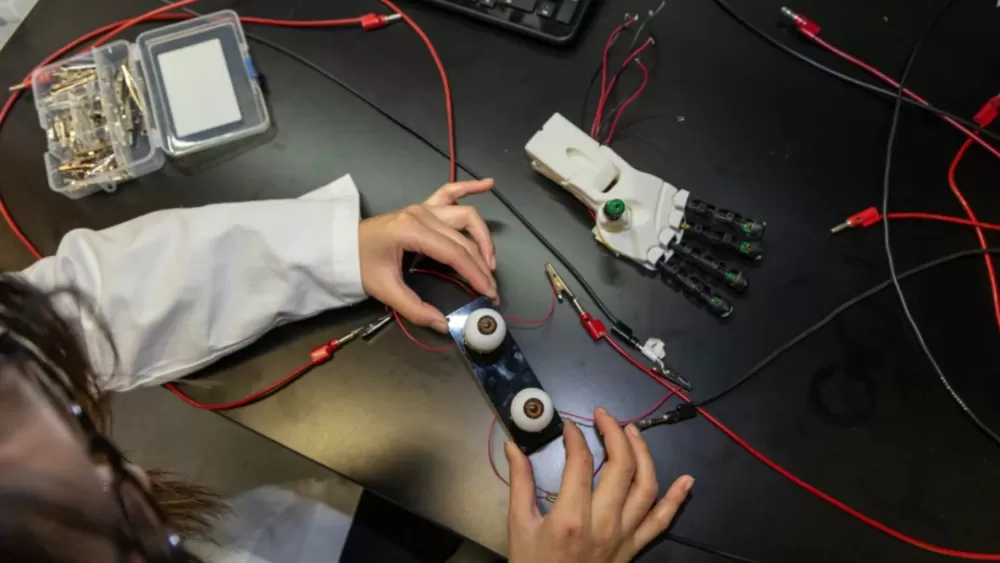
To really put their artificial muscles to the test, the Penn researchers incorporated them into a 3D-printed robot hand. And guess what? This isn't just some abstract lab experiment; this robot hand actually played the piano! Now, let's be clear, we're not talking about a rendition of Beethoven's Fifth here – not yet, anyway. But the demonstration, which showed the hand pressing keys with impressive variations in force and speed, was absolutely a working proof of concept. It beautifully showcased the muscle's ability to execute delicate, controlled actions, a far cry from the usual rigid push-button movements we often associate with robots.
Beyond the piano keys, these ingenious artificial muscles were also tasked with driving robotic eyeballs. Yes, you read that right – robotic eyeballs! Mounted on freely rotating ball joints, these simulated eyes could mimic human eye muscle function, achieving controlled and repeatable gaze shifts. What's particularly smart about this application is how the system simulates biological muscles working in opposing pairs. This clever design drastically reduces the number of control inputs needed, making the system incredibly efficient and, frankly, much more akin to how our own bodies operate. It’s a wonderful example of biomimicry in action.
The ultimate vision for this Penn research, then, is quite ambitious: to replace the rigid, clunky motors that currently limit robots, especially when it comes to subtle, nuanced movements in areas like faces and hands. Imagine a robot that could genuinely smile, frown, or offer a comforting touch with believable expression. Of course, the idea of truly lifelike robots can be a bit unsettling for some, bordering on the uncanny valley. But the potential for more natural human-robot interaction, for assistive technology that feels more empathetic, is truly immense. It’s about building robots that can communicate not just through words, but through subtle gestures and expressions, much like we do.
But hardware is only one side of the coin, isn't it? What good are incredibly agile muscles if a robot can't figure out how to use them intelligently? This is where another groundbreaking piece of research, this time from the USC Viterbi School of Engineering, really shines. Around the same time, their team developed a fascinating robotic system they've aptly named the "Musician Hand." What makes this particular robot so captivating isn't just its ability to play music, but how it learned to do so.
Picture this: after just two minutes of self-taught practice, this simple, tendon-driven robot flawlessly played a 30-note musical melody on a piano. Two minutes! That's astounding, especially when you consider it achieved this without extensive programming or massive datasets. Their approach involved something called "motor babbling," where the robot essentially explored its environment by randomly pressing keys to map out the physical relationships between its actions and the sounds produced. Then, it converted the musical melodies into a "Spectrogram," allowing its AI to process and understand the sonic patterns. It’s a stark contrast to the old-school method of painstakingly coding every single movement.
The implications of the "Musician Hand" extend far beyond just playing a catchy tune. This research vividly demonstrates a machine's capacity to learn complex skills from brief, real-world experiences, and then adapt to unpredictable environments. Imagine personalized assistive technologies that could quickly learn a user's unique needs and adapt their functions on the fly. It suggests a future where robots aren't just following pre-programmed instructions, but are genuinely learning and evolving alongside us, making them far more useful and integrated into our daily lives.
Taken together, these two distinct yet complementary advancements paint a truly exciting picture of the future of robotics. On one hand, we have the University of Pennsylvania's artificial muscles, imbuing robots with a physical grace and expressive capability previously thought impossible. On the other, the USC Viterbi team is showing us how robots can acquire complex skills with astonishing speed and independence, essentially teaching themselves. The confluence of these innovations means we're rapidly moving towards robots that are not only physically agile and nuanced but also intelligently adaptive. It begs the question: how will these increasingly lifelike and learning machines shape our world, and perhaps, even our understanding of what it means to be 'human'?
Editorial note: Nishadil may use AI assistance for news drafting and formatting. Readers can report issues from this page, and material corrections are reviewed under our editorial standards.