Journey to the Zeptoverse: CERN Unlocks Universe's Tiniest Secrets, Hinting at New Physics
- Nishadil
- November 18, 2026
- 0 Comments
- 3 minutes read
- 9 Views
- Save
- Follow Topic
CERN Physicists Achieve Unprecedented Scale, Probing the 'Zeptoverse' in Search of Cosmic Answers
CERN scientists at the LHC have peered into the 'zeptoverse' – the smallest scale ever measured – by observing an incredibly rare particle decay, opening a crucial new frontier in the quest for physics beyond the Standard Model.
Imagine shrinking down, far beyond what any microscope can fathom, into a realm so impossibly tiny it challenges our very comprehension. That's precisely what physicists at CERN have managed to do. In a truly groundbreaking announcement made on November 3rd, 2026, researchers unveiled measurements from the 'zeptoverse' – a mind-boggling scale less than a hundred-trillionth of a visible light wavelength, or to put it simply, a billionth of a trillionth of a meter (a zeptometer!). This isn't just a technical achievement; it's an exhilarating step towards potentially cracking some of the universe's deepest mysteries.
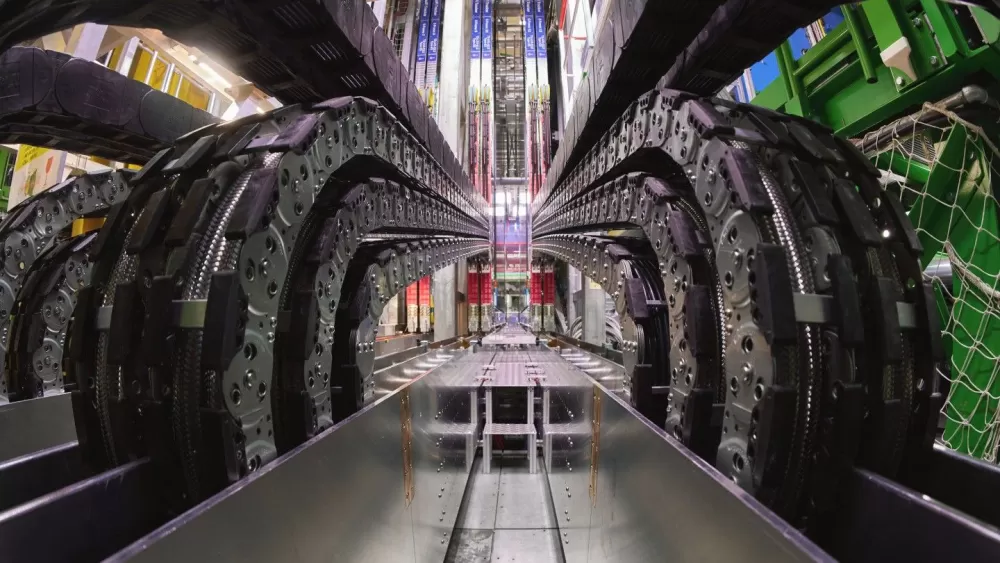
The stage for this incredible feat was the venerable Large Hadron Collider (LHC), nestled near Geneva on the border of France and Switzerland. Specifically, the LHCb experiment, which stands for 'Large Hadron Collider beauty,' was the star of the show. As its name suggests, LHCb is designed with a singular focus: to meticulously study particles containing 'beauty quarks.' These quarks, you see, have incredibly fleeting lives, existing for merely 1.5 trillionths of a second before decaying into something else. Observing their decay patterns offers a unique window into fundamental physics.
What the LHCb collaboration, which received a significant upgrade in 2024 to sharpen its particle distinguishing abilities, managed to observe is nothing short of extraordinary. They detected the first clear evidence of the rarest beauty-quark decay ever witnessed: a B0 meson transforming into a positive muon and a negative muon (B0 to mu+ mu−). Think about that for a moment – this particular decay happens only once in every ten billion beauty particles! The data leading to this pivotal discovery was painstakingly collected between 2011 and 2025, a testament to years of dedicated effort.
Now, here's where it gets really interesting. While the initial measurements of this specific decay aligned perfectly with the predictions of the Standard Model – our current, highly successful theory describing fundamental particles and forces – it's far from a 'normal' or 'disappointing' result, as some might initially think. In fact, it's thrilling! Why? Because by probing such extreme rarity and precision at the smallest scales imaginable, physicists are essentially opening a brand-new realm for exploration. This is precisely where subtle deviations, hints of 'new physics' beyond the Standard Model, might finally become evident.
The potential implications are monumental. This newfound precision could be our golden ticket to understanding some of the universe's most profound enigmas. We're talking about questions like: why is there so much more matter than antimatter in the cosmos? And what, exactly, is dark matter, that mysterious substance making up a huge chunk of the universe, yet remaining entirely elusive? Interestingly, there are already other ongoing anomalies in related beauty particle decays, which consistently fall below theoretical predictions, strongly suggesting that there is indeed something more to uncover beyond our current understanding.
Of course, this is science, and it's an ongoing journey. These fascinating findings are currently available as a preprint, meaning they're awaiting the rigorous scrutiny of peer review – a vital step in validating any scientific breakthrough. Moreover, particle physics always presents the challenge of ruling out the possibility that a signal is simply due to chance. And let's not forget the complex theoretical calculations involved in predicting these decay rates, which can lead to disagreements among theorists regarding the real uncertainties. Nevertheless, by pushing the boundaries to the 'zeptoverse,' CERN has given us the best chance yet to glimpse the universe's hidden mechanics and perhaps, finally, find that elusive 'new physics.'
Editorial note: Nishadil may use AI assistance for news drafting and formatting. Readers can report issues from this page, and material corrections are reviewed under our editorial standards.