A New Frontier: Trump's Ambitious Push into AI and Quantum Science
- Nishadil
- November 17, 2026
- 0 Comments
- 5 minutes read
- 16 Views
- Save
- Follow Topic
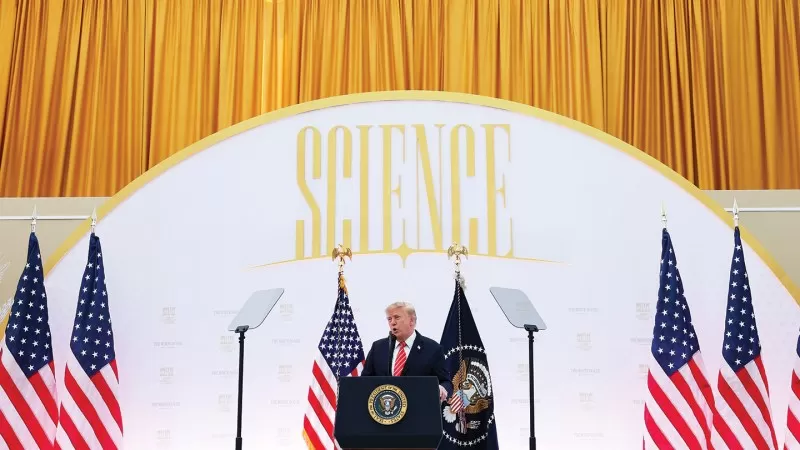
Trump Administration Invests Billions in AI and Quantum, Charting a Course for America's Scientific Future
Discover how the Trump administration committed billions to propel the U.S. to the forefront of artificial intelligence and quantum technology, initiating groundbreaking research and development.
The landscape of American science and technology saw a significant, proactive shift during the Trump administration. With a clear vision for cementing U.S. leadership in the next generation of technological innovation, the administration poured substantial federal resources into two incredibly promising, yet complex, fields: artificial intelligence and quantum computing. It wasn't just talk; we're talking about billions of dollars and a series of concrete legislative and executive actions designed to propel the nation forward.
One of the earliest and perhaps most foundational steps in this journey was back in 2018 when President Donald J. Trump signed the National Quantum Initiative Act into law. This wasn't a small gesture; it established a comprehensive, whole-of-government strategy with the explicit goal of ensuring American leadership in quantum science. Fast forward to June 22, 2026, and the administration doubled down, with President Trump signing an Executive Order aptly named "Ushering in the Next Frontier of Quantum Innovation." This order outlined a far-reaching federal strategy, pushing for accelerated development in quantum technology. Imagine federally supported quantum computer programs, coupled with brand new work on advanced quantum sensors and networks – that's what was envisioned.
Indeed, the ambition here was palpable. The Energy Department, through its Quantum Genesis Q Competition, identified eight specific scientific applications to guide its quest, earmarking a planned funding of up to $215 million. The target? To develop scientifically useful, error-corrected quantum computers by a pretty aggressive deadline of 2028. And it didn't stop there; there was even a directive for the (then) Secretary of War—an interesting historical title, perhaps referring to the modern Secretary of Defense—to pinpoint and prioritize at least three next-generation quantum sensor projects, aiming to field these by September 30, 2028. Talk about a focused push!
But quantum was only half the story. Artificial intelligence, with its transformative potential across nearly every sector, also received immense attention. November 24, 2025, marked the official launch of the "Genesis Mission" with President Trump's signature on an Executive Order. This wasn't just another initiative; it was billed as a national, government-wide effort—a staggering $5 billion commitment—specifically designed to leverage AI in revolutionizing scientific research. The idea, you see, was to usher in what the White House Office of Science and Technology Policy later described in a 123-page report as a "golden age" of federal science, driven largely by AI's capabilities.
The Genesis Mission, while monumental, wasn't a standalone endeavor. It built upon earlier groundwork, such as the April 23, 2025 Executive Order focused on "Advancing Artificial Intelligence Education for American Youth," recognizing the critical need to cultivate future talent. Then, on June 2, 2026, another Executive Order, "Promoting Advanced Artificial Intelligence Innovation and Security," further solidified the administration's commitment. In fact, federal agencies were already spending quite a bit, approximately $4.2 billion on AI research and development just in 2025 alone, indicating a sustained and growing interest.
The scale of these commitments truly became evident by October 9, 2026, when the Trump administration unveiled over $6 billion in new science initiatives. This figure was massive, encompassing the quantum computing competition we mentioned earlier and a remarkable $2.4 billion in pledges from industry partners dedicated to developing new AI tools and computing resources. It clearly demonstrated a holistic strategy: federal investment paving the way, with industry stepping in to accelerate practical applications. Darío Gil, the Undersecretary for Science at the U.S. Department of Energy, would certainly have been a key player in steering some of these monumental efforts.
Of course, with such powerful, emerging technologies, there are always conversations about potential future impacts. Interestingly, financial watchdogs in the EU did voice some concerns in September (though the exact year isn't specified in relation to these announcements), warning that future, incredibly powerful quantum computers could theoretically undermine cryptographic systems safeguarding blockchains and financial transactions. It’s an important consideration, for sure. However, and this is a crucial point, no quantum computer capable of launching such attacks exists today, nor is it projected to be available in the immediate future. It serves as a reminder that while innovation sprints forward, responsible foresight is always part of the journey.
Ultimately, the Trump administration’s concerted push into artificial intelligence and quantum science, characterized by significant funding, strategic executive orders, and a clear focus on American leadership, marked a pivotal period. It represented an ambitious attempt to not only catch up but to truly lead the world in technologies poised to redefine everything from healthcare to national security, laying a foundation for what they hoped would indeed be a golden age of scientific discovery and technological advancement.
Editorial note: Nishadil may use AI assistance for news drafting and formatting. Readers can report issues from this page, and material corrections are reviewed under our editorial standards.