Senator Ben Cardin Joins Johns Hopkins for CSC’s 35‑Year Milestone
- Nishadil
- October 23, 2026
- 0 Comments
- 6 minutes read
- 10 Views
- Save
- Follow Topic
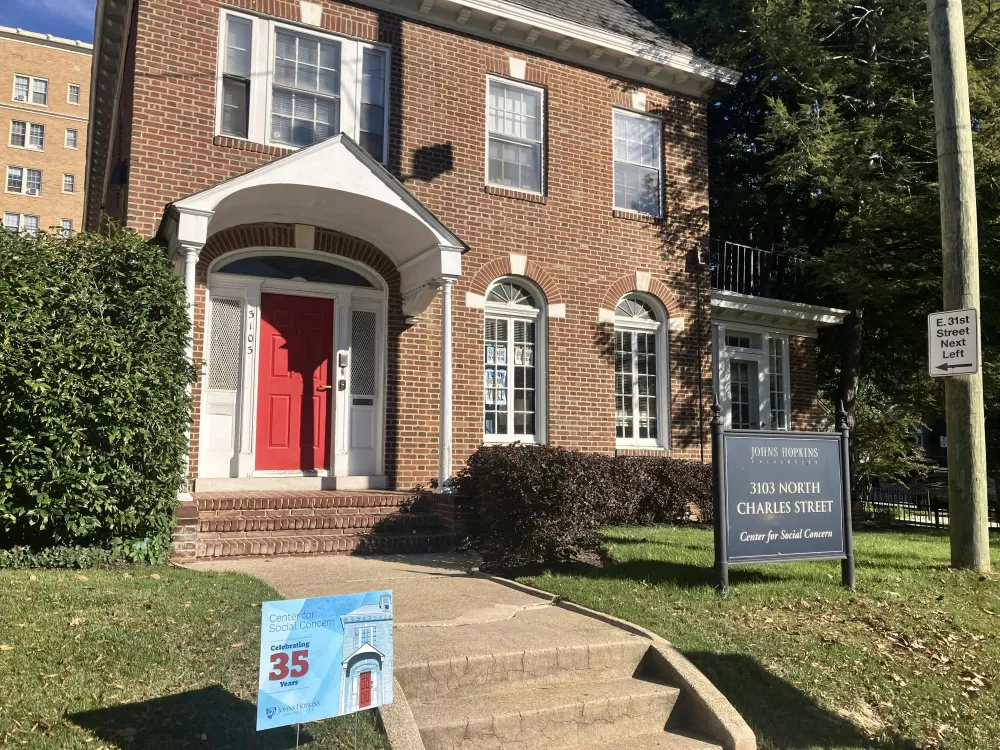
University hosts former Sen. Ben Cardin in celebration of CSC's 35th anniversary
The Center for Social Concern marked 35 years of community work with a lively ceremony, a keynote from Sen. Ben Cardin, and stories from alumni and faculty who’ve lived the mission.
On Wednesday, Oct. 14, the Johns Hopkins Center for Social Concern (CSC) turned its Levering Hall lobby into a mini‑museum, displaying photos, flyers and handwritten notes that trace three and a half decades of service in Baltimore. The exhibit, tucked between tables run by student‑staffed groups like the Tutorial Project, Baltimore First and Circle K, gave visitors a tangible sense of the center’s grassroots roots.
Luis Sierra Moncón, deputy director of CSC and head of Hopkins Votes, opened the evening with a land acknowledgment that reminded everyone the campus sits on the traditional homelands of the Piscataway and Susquehanna peoples. He then welcomed university president Ronald Daniels to the podium.
President Daniels thanked former Sen. Ben Cardin for accepting the role of keynote speaker, noting how the CSC’s 35th anniversary neatly overlaps with the university’s own 150th birthday. “The center’s commitment to truth‑seeking and civic action fulfills a dream that has animated Johns Hopkins from its very founding,” Daniels said, his voice warm but measured.
He paid tribute to historical figures who helped shape the university’s public‑service ethos, especially Chester Wickwire—an outspoken civil‑rights advocate and the founder of the Tutorial Project, a semester‑long tutoring program that pairs Hopkins undergraduates with elementary‑school students. Daniels also invoked the words of the school’s first president, Daniel Gilman, who believed that the university’s research mission was inseparable from a broader community responsibility. “Gilman reminded us that the work belonged not just to trustees, but to the whole community—everyone feels a sense of ownership, responsibility, and belonging,” Daniels emphasized.
Speaking from the heart, Daniels reminded the audience that when he first became president, the CSC didn’t have a dedicated space of its own. “We fought hard to give the Center a home of its own,” he recalled. “Today it stands not only as a building rooted in Baltimore, but as a living proof of our commitment to nurture democratic capacities and civic sensibilities in every student.”
Jasmine Blanks Jones, CSC’s executive director, then took the stage. She invited the crowd into a brief call‑and‑response ritual—“To those who came before us… and all that they left for us.” Jones highlighted the historic Baltimore Free University (1969‑1984), an adult‑education venture that offered courses ranging from social‑justice theory to practical trade skills. She also cited a 1999 Baltimore Sun piece that warned Hopkins students often volunteered without questioning systemic roots of inequality. “Volunteer work matters, but it doesn’t get at the root of the problem,” she quoted a student as saying, “It’s great to tutor kids, but we also have to ask why a tutoring program is needed in the first place.”
Jones used Wickwire’s 2005 reflection—standing in a senior‑citizen center where the only other Black Americans were the waitstaff—to illustrate that the work of integration and inclusion is far from finished.
Alumni stories followed. Emily Beca, who earned both undergraduate and graduate degrees at Hopkins, returned for the day to share a slice of her CSC experience. She recalled a low‑turnout Easter‑egg hunt organized by Best Buddies—an initiative for students with intellectual and developmental disabilities that lives under the CSC umbrella. “Four volunteers and I managed to pull off a successful hunt and a karaoke night,” Beca laughed. “It showed me the power of active collaboration with peers and mentors, and it gave me confidence that still guides my career.”
Next, Nate Brown, a professor in the University Writing Program and associate director of the Writing Center, reflected on his two‑year CSC fellowship. He described a semester‑long partnership with the Station North Tool Library, where his students interviewed the founders and wrote ethnographies for the library’s tenth‑anniversary celebration. The CSC covered the cost of individual library memberships, and twelve of the twenty students renewed after the first year—one even landed a job at the library, while another launched a tiny lending library in his parents’ condo building in Seoul.
“The Center for Social Concern gave me the administrative and instructional support, plus a community of civic‑minded students and faculty, to bridge a gap I thought was insurmountable,” Brown said, a hint of gratitude in his voice.
As the evening wound down, guests lingered by the Levering Hall exhibit, flipping through newspaper clippings and handwritten notes that chronicled the center’s evolution—from a modest tutoring hub to a full‑scale engine of community partnership. The sense was clear: 35 years of listening, learning, and leaning into Baltimore’s neighborhoods, with many more chapters still to write.
Editorial note: Nishadil may use AI assistance for news drafting and formatting. Readers can report issues from this page, and material corrections are reviewed under our editorial standards.