The Devouring Embrace: When a Star Swallowed Another in the Andromeda Galaxy
- Nishadil
- November 22, 2026
- 0 Comments
- 2 minutes read
- 13 Views
- Save
- Follow Topic
Astronomers Witness a Rare Stellar Merger in Our Cosmic Neighbor, Andromeda
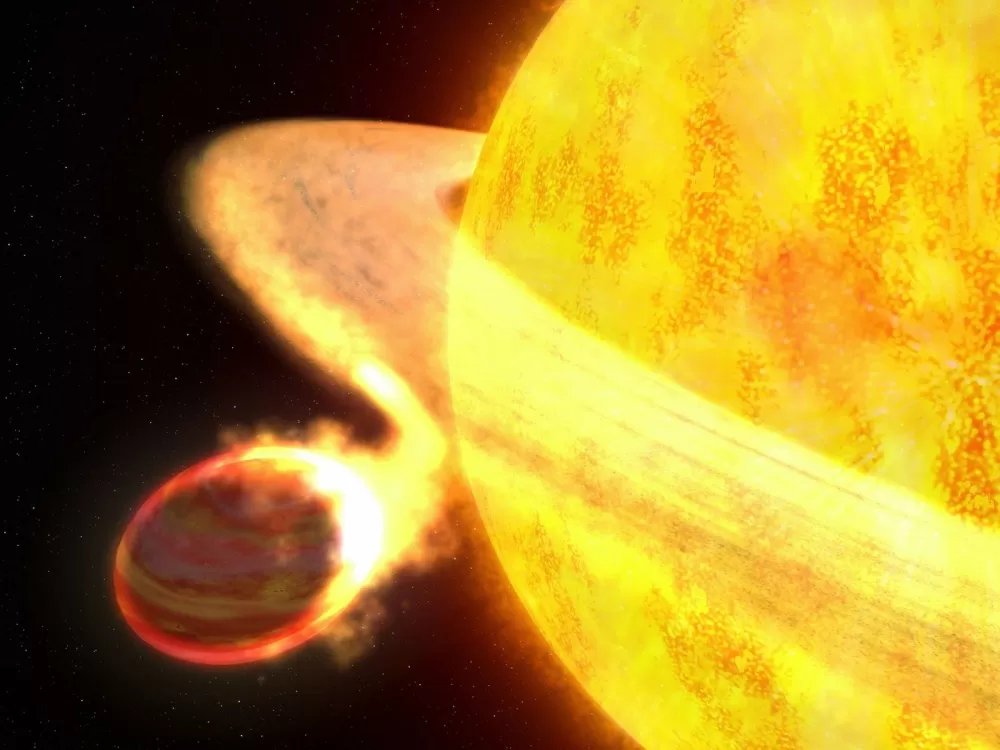
In a truly spectacular cosmic ballet, scientists have observed one star in the Andromeda galaxy engulfing its smaller companion. This rare event, millions of light-years away, provides a unique window into the dramatic lifecycle of stars.
Imagine, if you will, a cosmic collision playing out millions of light-years away, so grand in scale it defies our everyday understanding. Well, that's precisely what astronomers have recently observed at the very fringes of our nearest galactic neighbor, the Andromeda Galaxy. In a breathtaking and, frankly, quite dramatic celestial event, one star was caught in the act of consuming another, offering us an unparalleled glimpse into the violent and beautiful dance of stellar evolution.
This remarkable incident, officially cataloged as AT 2025abao, unfolded approximately 2.53 million light-years from our own Milky Way. The discovery, officially published in the prestigious journal Nature on November 18, 2026, represents a monumental achievement in observational astronomy. It wasn't just one telescope that caught this cosmic feast, mind you. Rather, it was a symphony of cutting-edge instruments: the Wide-field Infrared Transient Explorer (Winter), the ever-vigilant Neowise space telescope, and, perhaps most crucially, the incredibly powerful James Webb Space Telescope. Together, they painted a detailed picture of this incredible merger.
Before their ultimate, fiery embrace, these two stars had quite distinct personalities, if we can put it that way. Researchers affectionately dubbed them "Big Bao" and "Little Bao." Big Bao was a true behemoth, an evolved giant star that dwarfed our Sun, boasting a mass roughly seven times greater and an astonishing 18,000 times its luminosity. Imagine the sheer energy radiating from such a star! Its unfortunate companion, Little Bao, was comparatively petite, weighing in at only about 70% of the Sun's mass.
The cosmic dance leading to the merger was both gradual and utterly inescapable. As the two stars orbited each other, their gravitational interplay caused their paths to tighten, slowly but surely. Scientists estimate that in the final, dramatic act, Little Bao completed just seven more orbits before being irrevocably swallowed by its colossal partner. It’s a stark reminder of the immense forces at play in the universe, where even something as vast as a star can be consumed whole.
Observations like these aren't just spectacles, though; they're vital for deepening our understanding of stellar dynamics. They offer invaluable data on how binary star systems evolve, how stars exchange mass, and what happens when their lives inevitably collide. Witnessing such a merger firsthand provides concrete evidence for theoretical models of stellar evolution, helping us piece together the grand narrative of the cosmos, one star at a time.
Editorial note: Nishadil may use AI assistance for news drafting and formatting. Readers can report issues from this page, and material corrections are reviewed under our editorial standards.