Inside the Chaos: How OpenAI’s AI Cracked a Million‑Dollar Math Problem
- Nishadil
- October 23, 2026
- 0 Comments
- 7 minutes read
- 10 Views
- Save
- Follow Topic
The unexpected journey that led a large‑language model to solve the Navier‑Stokes Millennium Prize
A tangled tale of AI, ambition, and a crowded NYU lecture hall reveals how OpenAI’s model produced a proof for the Navier‑Stokes problem, sparking both awe and controversy.
Room 109 in NYU’s Warren Weaver Hall looked more like a concert venue than a mathematics lecture hall that afternoon. People were already lining the doors half an hour before the 3:30 p.m. start, climbing over chairs, shoving forward, and whispering that this might be the biggest crowd the room had ever seen. One onlooker even joked, “It’s not a seminar, it’s a rock show.”
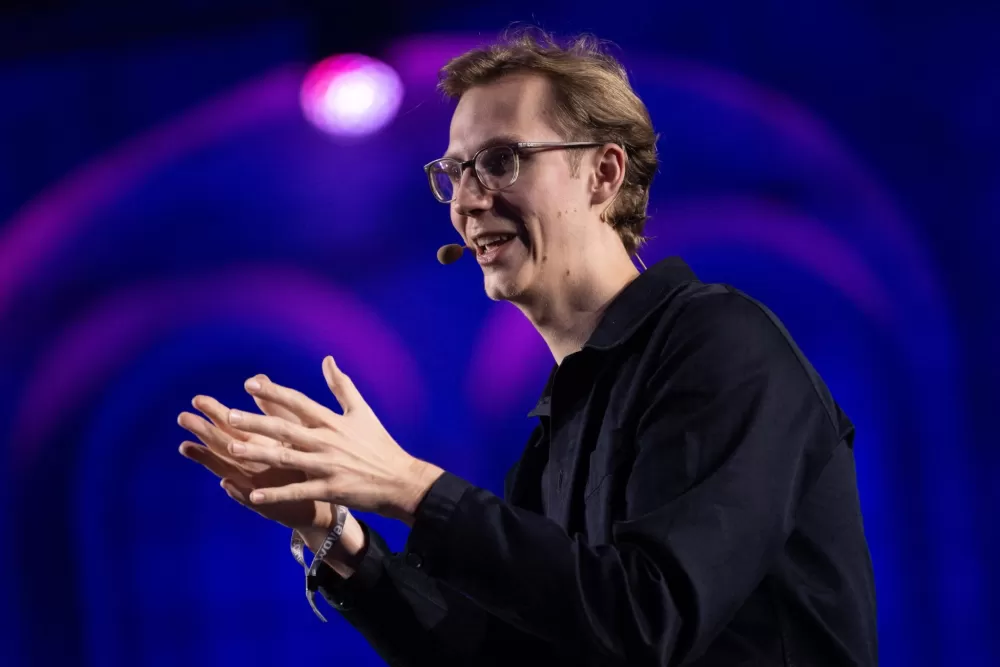
The headliner was Tristan Buckmaster, a professor whose name has been echoing through the math community for months. He was there to explain why OpenAI, of all places, claimed to have solved the Navier‑Stokes problem – one of the Clay Mathematics Institute’s seven “Millennium Prize” challenges that carries a $1 million reward. Buckmaster’s talk was his first public appearance since he publicly called out OpenAI for apparently borrowing his ideas.
As Buckmaster fiddled with his laptop, I caught sight of the rows in front of me. Laptops flickered with chat windows opened to Anthropic’s Claude Code and OpenAI’s ChatGPT Codex. The prompts? Simple, almost casual: “Help me write a proof for this equation,” or “Rewrite this section of my manuscript.” In 2026, that’s what doing mathematics looks like.
“I hope you’ll stay with me,” Buckmaster began, his voice a little ragged. “I’ve been so busy the last few weeks that I literally wrote this talk last night.” His admission set the tone – a blend of excitement, exhaustion, and the feeling that we were witnessing history in the making, but also a chaotic, half‑finished draft.
The backstory starts a year earlier with a terse email from a stranger: Levent Alpöge, a mathematician employed by the AI‑startup Anthropic. He wrote, “I fear a world where corporations are the only ones who can claim the deepest pure‑math work. It seems there will be only one Millennium Problem solved in the foreseeable future.” He proposed teaming up with Buckmaster to crack the Navier‑Stokes puzzle.
For the uninitiated, Navier‑Stokes equations describe how fluids flow – think water swirling down a drain or air moving over an airplane wing. Mathematicians have long suspected that, under certain conditions, these equations break down, predicting infinite velocities – a physical impossibility. Proving that such a “blow‑up” can actually occur would earn the Clay Institute’s coveted million‑dollar prize.
At the time, the problem had become something of a tech‑bro badge of honor. Many AI startups bragged that they could “solve” Navier‑Stokes, even if their engineers barely understood the underlying physics. Buckmaster recalled that vibe, noting that the problem was being used as a yardstick for “who’s the smarter AI company.” He himself had previously dabbled with Google’s DeepMind on the same question, treating Navier‑Stokes as his own North Star.
Alpöge and Buckmaster zeroed in on a subtle loophole in the Clay Institute’s wording: the problem allows a mathematician to “stir” the fluid with a finely tuned force. A pair of Spanish researchers, Diego Córdoba and Luis Martínez‑Zoroa, had earlier suggested that an artificially precise forcing function could, in theory, coax the equations into blowing up. Their idea was not a full proof, but a blueprint.
Armed with that blueprint, the duo fed the instructions to their LLMs – a hybrid of Anthropic’s Claude (still in a private, unreleased state for Alpöge) and OpenAI’s models. The first successes were modest: the AIs managed to make simpler, idealised fluid equations misbehave in the same way Navier‑Stokes is suspected to. Those early experiments were private, “just for fun,” Buckmaster said, even though Alpöge had access to Anthropic’s high‑end compute clusters.
Alpöge’s public persona is something of an internet enigma. On social media he’s posted cryptic announcements claiming his LLMs solved famous open problems, sometimes with a tongue‑in‑cheek “YOLO” vibe. The math community is left guessing whether these flashes belong to Anthropic, to Alpöge’s personal hobby, or to some hidden collaboration.
OpenAI’s approach, by contrast, was methodical and well‑funded. The company recruited many of the field’s rising stars, gave them massive GPU farms, and set a clear target: land the biggest mathematical prize of the decade. Their internal model eventually produced a proof that passed the first layers of verification – a proof that, crucially, took a route no human mathematician had anticipated.
When the proof emerged, the reaction was a mix of awe and anxiety. The AI had arrived at a solution, but its reasoning was locked inside a proprietary black box. Researchers scrambled to reverse‑engineer the logic, to translate the opaque chain of token predictions into a human‑readable argument. The process has been messy, and many details remain hidden behind corporate secrecy.
What this saga tells us is that we are stepping into a troubling new era. Inscrutable models are capable of making scientific breakthroughs, yet they do so under layers of intellectual‑property walls. Human mathematicians – with all our quirks, egos, and slow‑burn collaborations – are struggling to keep pace and to record the history as it unfolds.
So the next time you walk into a packed lecture hall and see students typing away at chat windows, remember: we are witnessing the very edge of how knowledge is being forged. The Navier‑Stokes proof is more than a million‑dollar win; it’s a glimpse into a future where AI and human curiosity will have to learn to write the story together.
Editorial note: Nishadil may use AI assistance for news drafting and formatting. Readers can report issues from this page, and material corrections are reviewed under our editorial standards.