Commutative Property: What It Is and Why It Matters
- Nishadil
- October 22, 2026
- 0 Comments
- 2 minutes read
- 14 Views
- Save
- Follow Topic
When Order Doesn’t Matter: The Commutative Property Explained
A friendly look at the commutative property—why swapping numbers in addition or multiplication never changes the answer, plus a quick contrast with non‑commutative operations.
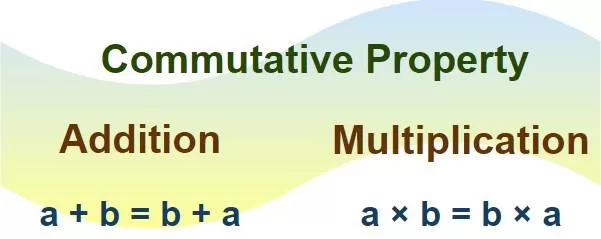
The commutative property is one of those tidy little rules in mathematics that says, essentially, \"it doesn’t matter which way you write the numbers, the result stays the same.\" In everyday terms, if you add 2 + 3 you’ll get the same 5 as when you write 3 + 2. The same goes for multiplication: 4 × 5 equals 5 × 4.
This rule holds for the two core operations we use most—addition (+) and multiplication (×). It’s a handy shortcut, especially when you’re trying to simplify an expression or check your work.
Commutative property of addition
For any two numbers, say X and Y, the formula is simply X + Y = Y + X. A few quick examples make it clear:
- 4 + 7 = 7 + 4 = 11
- (‑12) + 5 = 5 + (‑12) = ‑7
- \(\frac{8}{9}\) + \(\frac{1}{3}\) = \(\frac{1}{3}\) + \(\frac{8}{9}\) = \(\frac{11}{9}\)
Commutative property of multiplication
Similarly, for multiplication we have X × Y = Y × X. Some plain‑vanilla examples:
- 4 × 7 = 7 × 4 = 28
- (‑12) × 5 = 5 × (‑12) = ‑60
- \(\frac{8}{9}\) × \(\frac{1}{3}\) = \(\frac{1}{3}\) × \(\frac{8}{9}\) = \(\frac{8}{27}\)
Operations that are not commutative
Not every arithmetic operation follows this friendly rule. Subtraction and division are the usual suspects—swap the numbers and the answer changes.
For subtraction, R − S is generally not the same as S − R. For instance, 35 − 15 = 20 while 15 − 35 = ‑20. Division is similar: 12 ÷ 3 = 4 but 3 ÷ 12 = ¼.
Commutative vs. associative
It’s easy to mix up the commutative property with the associative property. The former cares about the order of the numbers; the latter cares about how the numbers are grouped. In symbols:
- Commutative: A + B = B + A, A × B = B × A
- Associative: A + (B + C) = (A + B) + C, A × (B × C) = (A × B) × C
Both properties are useful, but they address different aspects of arithmetic manipulation.
Practice makes perfect, so try a few problems on your own. Swap the numbers in a sum or product and see the result stay put. Then experiment with subtraction or division to feel the difference. That’s the essence of the commutative property—order doesn’t matter, at least for addition and multiplication.
- India
- News
- Technology
- TechnologyNews
- Pcm
- Addition
- Picked
- MathConcepts
- MathematicalOperations
- ArithmeticOperators
- MathsClass7
- CommutativeProperty
- OrderOfOperations
- AssociativeProperty
- CommutativePropertyDefinition
- CommutativeLaws
- CommutativeLawForAddition
- NonCommutativeOperations
- SwitchingOperands
- CommutativePropertyOfAddition
- CommutativeFormula
- Multiplication
- MathExamples
- ArithmeticRules
Editorial note: Nishadil may use AI assistance for news drafting and formatting. Readers can report issues from this page, and material corrections are reviewed under our editorial standards.