A New Cosmic Neighbor? Scientists Hypothesize a Distant Planet Twice Earth's Mass
- Nishadil
- November 25, 2026
- 0 Comments
- 4 minutes read
- 9 Views
- Save
- Follow Topic
Beyond Neptune: A Mysterious Planet Could Be Hiding in Our Solar System's Far Reaches
A recent study suggests a planet roughly twice Earth's mass might exist far beyond Neptune, influencing the strange orbits of icy outer solar system objects.
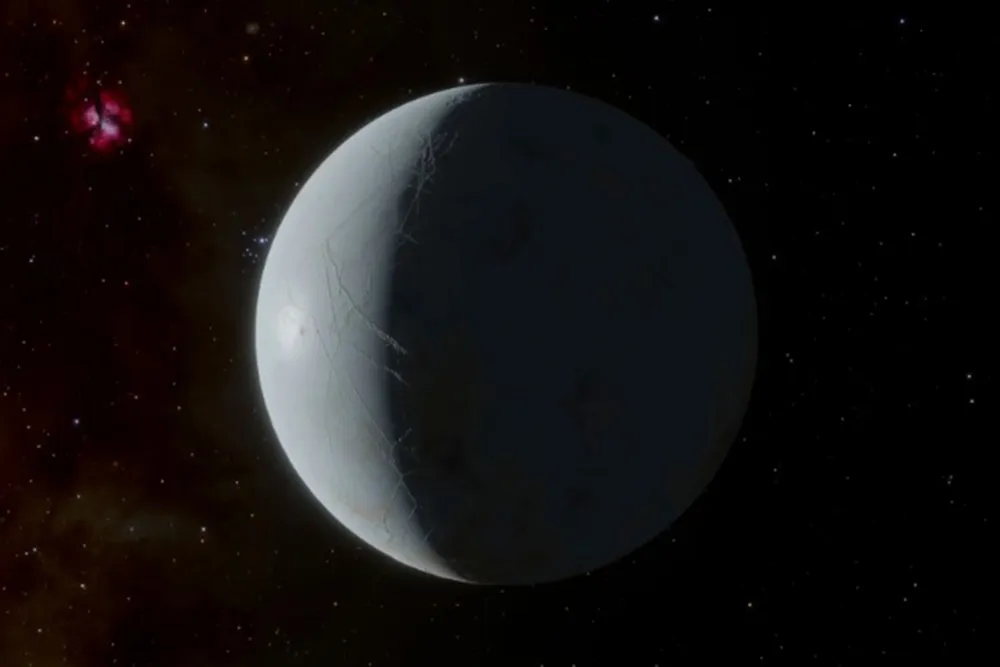
Our solar system, as vast as it seems, might just be holding onto a colossal secret. Imagine, if you will, a world out there, lurking in the frigid, dark expanse far beyond Neptune – a planet potentially twice the mass of our own Earth. It’s a truly tantalizing thought, isn't it? And now, a groundbreaking new study is lending some serious weight to this very idea.
Astronomers have, for a while now, been scratching their heads over the peculiar dance of certain icy objects way out in the outer solar system. We’re talking about those distant, frozen bodies that seem to follow unusually elongated or steeply inclined paths – almost as if something unseen is subtly tugging at them, gently guiding their cosmic ballet. Well, this new hypothesis, which introduces a theoretical planet we can informally call Planet X2 (or PX2), proposes that this unseen gravitational influence could be the culprit.
So, what kind of world are we talking about here? The simulations suggest this elusive celestial body could be roughly twice the mass of Earth. And its orbit? It's mind-bogglingly distant. We're looking at an average distance of anywhere from 350 to 500 astronomical units (AU) from the Sun. To put that into perspective, one AU is the distance from Earth to the Sun – about 150 million kilometers. So, we're talking about a world that’s hundreds of times further out than Earth, potentially no closer than 200 times our own distance from the Sun. It’s an incredibly cold, dark, and solitary place, I can tell you.
This fascinating work comes from a dedicated team of researchers, led by Dr. Patryk Sofia Lykawka of Kindai University in Japan. He, along with co-authors Pedro Bernardinelli from the University of Washington and Jonathan Horner of the University of Southern Queensland, didn't just pull this idea out of thin air. Their findings, published on November 23, 2026, in the esteemed Monthly Notices of the Royal Astronomical Society, are the result of some seriously intense computational heavy lifting. They ran computer simulations spanning an incredible 4.5 billion years – essentially modeling the entire age of our solar system – to see how a hypothetical planet might influence these distant icy objects.
Now, if this whole idea of a mysterious, distant planet sounds a bit familiar, you’re probably thinking of Planet Nine. And you'd be right to make that connection! Back in 2016, Caltech astronomers Konstantin Batygin and Mike Brown proposed Planet Nine, suggesting a much more massive planet – five to ten times Earth's mass – to explain different patterns in other distant Kuiper Belt objects. It's important to understand that Planet X2 is a distinct hypothesis. Think of it this way: our solar system might just be big enough to host both these hidden giants. They aren't mutually exclusive, which is a pretty exciting thought, if you ask me!
Of course, and this is crucial to remember, neither Planet X2 nor Planet Nine has been directly observed. They are, at this stage, compelling theoretical constructs, born from the subtle gravitational whispers we detect from the edge of our solar system. These simulations are powerful tools for understanding possibilities, but they aren't the same as actually seeing a new planet. The hunt is very much still on! The universe, even our own cosmic backyard, continues to hold so many secrets, constantly urging us to look further, to wonder more, and to keep pushing the boundaries of what we know. It truly makes you ponder what other wonders might be out there, just waiting to be discovered.
Editorial note: Nishadil may use AI assistance for news drafting and formatting. Readers can report issues from this page, and material corrections are reviewed under our editorial standards.