When a Star Meets Its End: How a Black Hole's Hunger Can Light Up a Galaxy
- Nishadil
- April 18, 2026
- 0 Comments
- 3 minutes read
- 29 Views
- Save
- Follow Topic
A Cosmic Light Show: When Shredded Stars Briefly Illuminate Entire Galaxies
Discover the dramatic, yet illuminating, fate of a star caught too close to a supermassive black hole, turning a galactic core into a temporary beacon of light for astronomers across the cosmos.
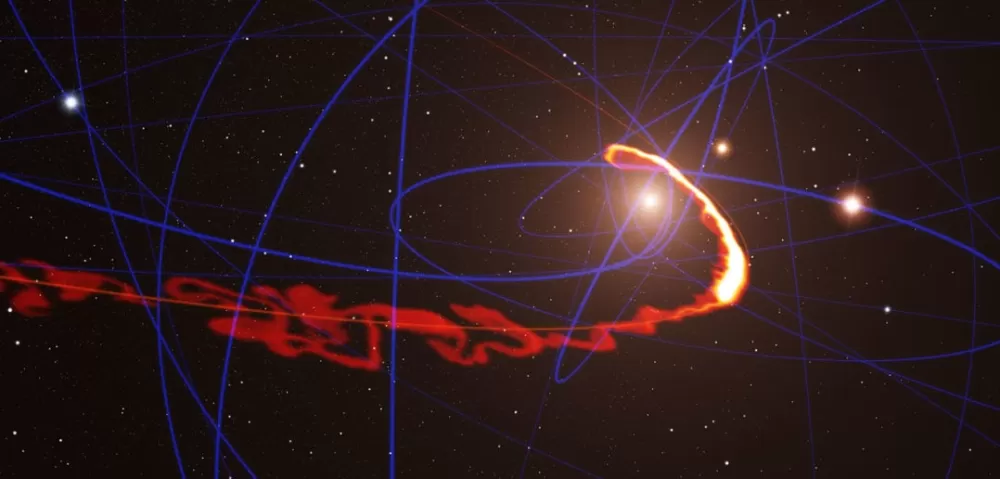
Imagine, if you will, a star, much like our own Sun, peacefully orbiting in its home galaxy. Suddenly, it veers a little too close to the galactic core, a region dominated by a supermassive black hole, an entity with gravity so immense that nothing, not even light, can escape. This isn't some gentle gravitational nudge; it's a death sentence, a spectacular and terrifying cosmic ballet known as a Tidal Disruption Event, or TDE for short. And here's the kicker: this violent destruction can actually light up an entire galaxy, turning it into a temporary beacon across the vastness of space.
So, what exactly happens during one of these jaw-dropping events? Well, as the unsuspecting star wanders into the black hole's perilous gravitational grasp, the side of the star closer to the black hole experiences a much stronger pull than the side facing away. This differential force, known as tidal force, stretches the star like a piece of cosmic taffy. Eventually, it reaches a point where the star's own gravity can no longer hold it together. Poof! It's shredded, quite literally, into a long, thin stream of gas and dust.
But this isn't just a tale of destruction; it's also a story of extraordinary light. Part of that shredded stellar material gets flung out into space, perhaps to seed new stellar nurseries someday. However, a significant portion of it doesn't escape. Instead, it gets captured by the black hole's gravity and begins to spiral inward, forming a swirling, superheated accretion disk around the black hole's event horizon. As this material grinds together at incredible speeds and temperatures, it emits an enormous burst of energy across the electromagnetic spectrum – X-rays, ultraviolet light, and even visible light. It's truly astronomical fireworks!
The resulting flare can be so incredibly bright that it temporarily outshines all the other stars in the host galaxy combined. For a short period, perhaps a few months to a couple of years, what might have been a relatively dim galaxy suddenly blazes with an intensity that's detectable by telescopes millions, or even billions, of light-years away. It's a rare and precious glimpse into the otherwise dark heart of a galaxy.
What makes these events so incredibly valuable to us, you ask? Well, for one, they offer a unique opportunity to study supermassive black holes themselves. Since black holes are, by definition, invisible, we can only infer their presence and study their properties by observing their effects on surrounding matter. TDEs act like cosmic probes, illuminating the black hole's immediate environment and allowing astronomers to measure its mass, spin, and the characteristics of the gas falling into it. They also help us find dormant black holes that aren't actively accreting material most of the time.
Astronomers are always on the lookout for these spectacular, yet fleeting, cosmic dramas. The observation of events like AT2019dsg, where a black hole dramatically shredded a star, provided an unprecedented view of this violent process. By combining data from various telescopes across different wavelengths, scientists can piece together the story of the star's demise and the resulting light show. So, next time you gaze up at the night sky, remember that out there, in some distant galaxy, a black hole's ravenous hunger might just be painting a temporary masterpiece of light.
Editorial note: Nishadil may use AI assistance for news drafting and formatting. Readers can report issues from this page, and material corrections are reviewed under our editorial standards.