
The Ten Commandments in Texas Schools: A Fundamental Clash of Faith and Law
- Nishadil
- April 22, 2026
- 0 Comments
- 3 minutes read
- 30 Views
- Save
- Follow Topic
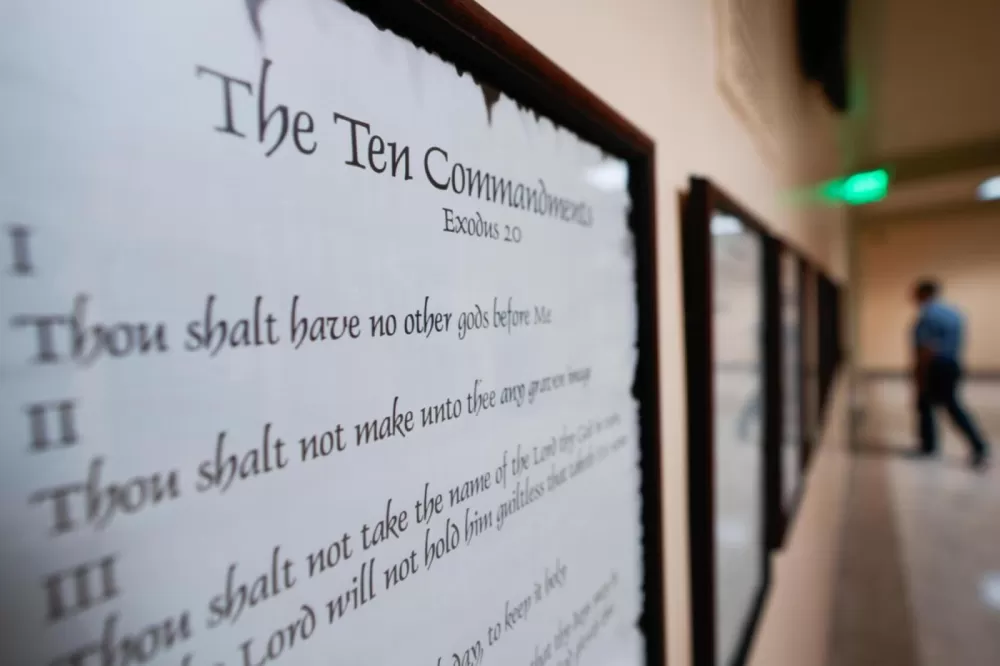
Federal Court Pumps the Brakes on Texas Ten Commandments Law, Citing Deep Constitutional Concerns
A recent federal court ruling has temporarily blocked a Texas law requiring the display of the Ten Commandments in public school classrooms, reigniting the contentious debate over church and state separation and what role, if any, religion should play in public education.
Well, here we are again, wrestling with that age-old American question: where exactly do we draw the line between church and state, especially when it comes to our public schools? Texas, as you might have heard, recently passed a law that really pushes the envelope, mandating that the Ten Commandments be prominently displayed in every single public school classroom. But hold on a minute, because a federal court has just stepped in, putting a temporary stop to this whole endeavor, and trust me, the reasons behind it are pretty profound.
You see, this isn't just a simple matter of hanging a poster. The law, House Bill 71, specifically requires printed copies of the Ten Commandments – in a certain font size, no less – to be visible in all public elementary and secondary school classrooms. For many, especially those who championed the bill, it's about providing a moral compass, a set of foundational principles, or perhaps even recognizing what they view as a historical document. They argue it's not about establishing a religion, but rather about acknowledging the historical and cultural significance of the Commandments in Western law.
However, that's where the rubber meets the road, isn't it? Opponents, including a coalition of civil liberties groups and concerned parents, see things very differently. Their argument, which the federal court seems to be siding with, at least for now, centers squarely on the First Amendment's Establishment Clause. That's the part of our Constitution that famously says the government can't establish a religion. When the state dictates that a specific religious text must be displayed in a public, secular setting like a school, critics contend it effectively endorses that religion, making students of different faiths – or no faith at all – feel like outsiders or that their beliefs are less valued.
It’s not hard to imagine, really. Picture a classroom. If one particular religious text is front and center, what message does that send to a Jewish student, a Muslim student, or even an atheist student? Does it subtly, or not so subtly, pressure them towards a particular worldview? That's the very kind of coercion the Establishment Clause aims to prevent. The court's decision, in granting this preliminary injunction, essentially signals that the plaintiffs have a strong likelihood of proving that this Texas law is unconstitutional. It's a significant early victory for those advocating for a clear separation.
Now, this isn't the final word, by any means. This legal battle is far from over, and you can bet your bottom dollar that the state of Texas will appeal. We're likely looking at a prolonged fight that could, quite conceivably, make its way all the way up to the Supreme Court. Such a scenario would place this debate squarely back in the national spotlight, forcing a re-evaluation of how religious displays are treated in public spaces, particularly in educational environments where children are so impressionable.
This entire situation really underscores a perennial tension in American society: how do we balance the deeply held religious beliefs of many with the constitutional imperative to keep government neutral on matters of faith? It's a conversation that touches on everything from personal conviction to civic duty, and as this Texas case vividly illustrates, there are no easy answers, just ongoing, passionate debate that shapes the very fabric of our public life and, critically, our children's schooling experiences.
Editorial note: Nishadil may use AI assistance for news drafting and formatting. Readers can report issues from this page, and material corrections are reviewed under our editorial standards.


