Giant cockroach effigy ignites political flare‑up at Delhi’s Dussehra celebrations
- Nishadil
- October 21, 2026
- 0 Comments
- 3 minutes read
- 2 Views
- Save
- Follow Topic
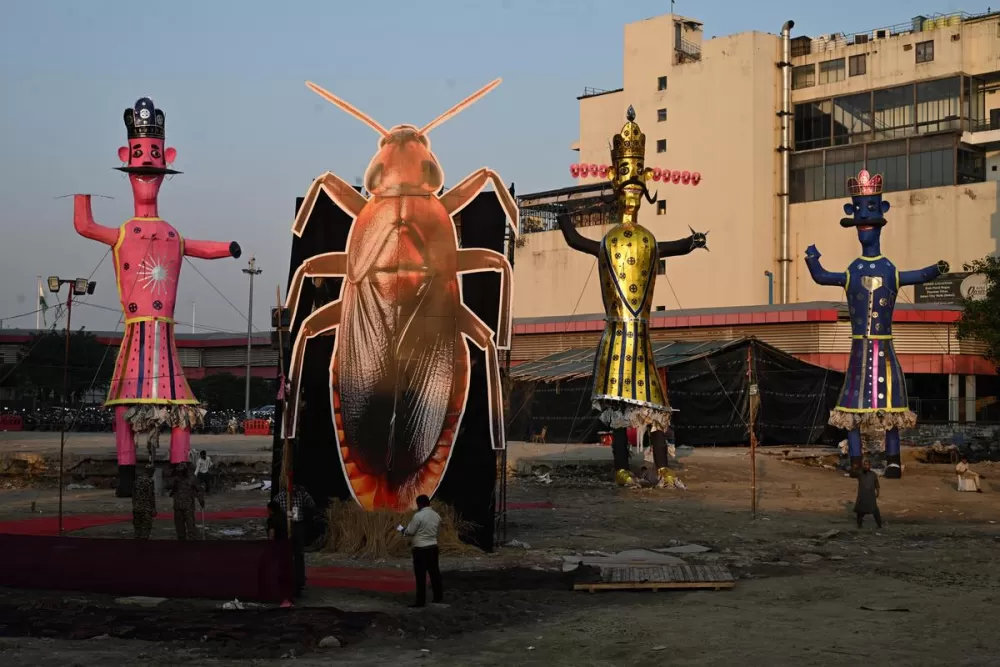
A 30‑foot cockroach at Ramlila sparks AAP‑BJP showdown over religion and ‘cleanliness’
When a towering cockroach effigy was set ablaze alongside Ravana’s during Delhi’s Dussehra, the AAP lodged a complaint, accusing the organisers of hurting religious feelings, while the BJP defended it as a symbol of eradicating ‘filth’.
On the evening of October 20, 2026, the usual roar of drums and chants at the Shri Keshav Ramlila in Pitampura was punctuated by an odd, unmistakable sight – a 30‑foot‑tall effigy of a cockroach, its glossy black body looming over the crowd. When the pyre was lit, the massive insect sizzled and curled, its legs snapping in the heat, right beside the traditional figures of Ravan, Kumbhkaran and Meghnad.
The spectacle, intended by organisers as a visual cue for “cleanliness” and the eradication of filth, instantly turned into a political tinderbox. The Aam Aadmi Party (AAP) rushed to the Lieutenant Governor’s office, filing a formal complaint that the cockroach symbol was a deliberate affront to Sanatan Dharma and a ploy to mock the sanctity of Dussehra.
In the complaint, AAP named the Shri Keshav Ramlila Committee, its president and BJP MLA Ashok Goel, as well as Delhi’s Labour Minister Kapil Mishra, accusing them of “deliberately hurting religious sentiments” by introducing the un‑orthodox effigy. The party’s Delhi unit chief, Saurabh Bharadwaj, warned that such gimmicks betray a deeper political motive – “a thinly veiled attempt to undermine the cultural fabric of the festival and to score points against the people of Delhi.”
The BJP, not one to sit quietly, hit back almost immediately. Ashok Goel, speaking to reporters, said the cockroach was meant to represent “the filth that rots society,” and its burning was a symbolic cleansing. He dismissed the AAP’s outrage as “politics over a puppet,” adding that the party’s loss of power in the capital had perhaps left it “more sensitive to any perceived slight.”
Adding an unexpected twist to the drama, Abhijeet Dipke, founder of the self‑styled Cockroach Janta Party (CJP), posted a tongue‑in‑cheek thank‑you note on social media, claiming the organizers had given his fledgling party “free publicity” by letting the giant roach take centre stage.
Meanwhile, Labour Minister Kapil Mishra tried to steer the conversation back to the practical angle, saying the effigy was a “visual reminder of the need for cleanliness, especially in a post‑pandemic world.” He hinted that the criticism was being fanned by “naxalites and corrupt forces” seeking to “stir unnecessary controversy.”
Local residents offered a mixed chorus of reactions. Some applauded the bold visual metaphor, saying it reminded them to keep their homes pest‑free. Others felt uneasy, noting that Dussehra has traditionally been a solemn reenactment of the triumph of good over evil, and the cockroach, for many, seemed a jarring addition.
As the flames died down, the ash‑covered giant lay still, a stark reminder that even a seemingly harmless prop can spark a firestorm when politics, religion, and public sentiment collide.
Editorial note: Nishadil may use AI assistance for news drafting and formatting. Readers can report issues from this page, and material corrections are reviewed under our editorial standards.