The Universe's Blueprint: A Grand Design, or Just Our Best Guess?
- Nishadil
- November 15, 2025
- 0 Comments
- 3 minutes read
- 57 Views
- Save
- Follow Topic
Our Universe's Model: A Triumph, But Not Without Its Cosmic Quirks
The Standard Cosmological Model offers an elegant framework for our universe's evolution, but it's not without its profound mysteries and nagging inconsistencies. Explore the reigning theory and the compelling alternatives scientists are considering.
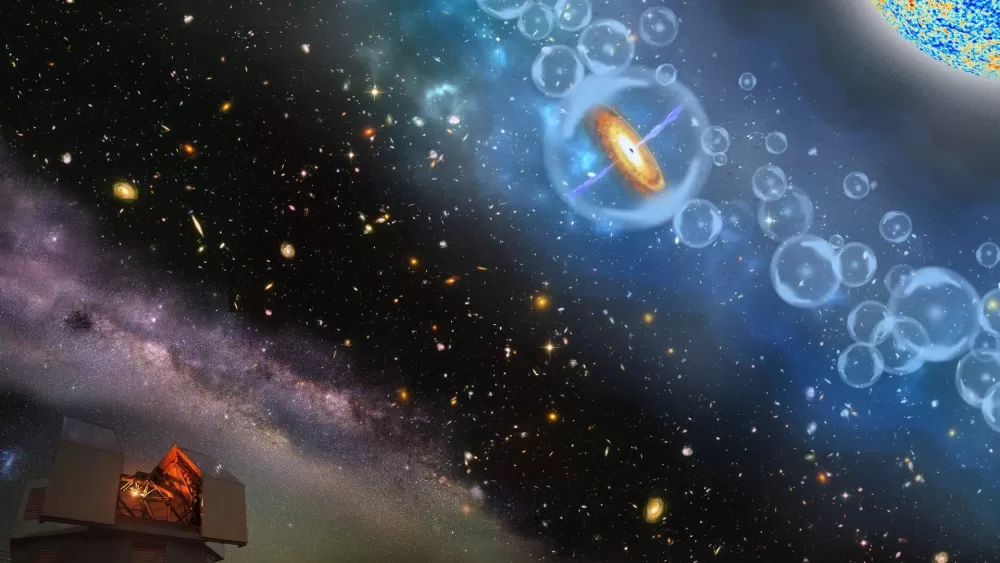
For ages, humanity has gazed up at the night sky, a boundless tapestry of stars and mysteries, yearning to grasp the grand design, the underlying rules of it all. And in truth, we've come a remarkable way. Our current reigning champion, the Standard Cosmological Model—or more formally, Lambda-CDM—offers, you could say, a rather elegant framework for how our universe came to be and how it’s evolving. It’s simple enough, powerful even, a real workhorse in explaining the cosmos. But here’s the thing about models, isn't it? They're never truly the whole picture, are they?
This Lambda-CDM model, it posits a universe born from a hot, dense state—the Big Bang, of course—and ever since, it's been expanding. Not just expanding, but accelerating in its expansion, propelled by something we've rather mysteriously dubbed 'dark energy.' Then there’s 'dark matter,' a phantom substance that doesn’t interact with light, yet its gravitational pull is absolutely crucial for holding galaxies together, for structuring the very fabric of the cosmos. Without it, well, everything would simply fly apart. Honestly, it sounds a bit like science fiction, doesn't it? A universe dominated by unseen, unknown forces.
And yet, for all its elusive components, this model has an impressive track record. It beautifully explains the Cosmic Microwave Background (CMB), that faint echo of the Big Bang itself, a relic radiation that bathes the entire universe. It also neatly accounts for the large-scale distribution of galaxies we observe, those vast cosmic webs and voids. Even the data from Type Ia supernovae, those 'standard candles' that help us measure cosmic distances, largely align with an accelerating universe. So, yes, the evidence supporting Lambda-CDM is robust, perhaps even overwhelmingly so.
But like any truly great scientific theory, it’s not without its wrinkles, its little moments of existential dread for cosmologists, you might say. Take the 'Hubble tension,' for instance. Different methods of measuring the universe's current expansion rate yield subtly, but stubbornly, different results. It’s a nagging inconsistency, a crack in the otherwise smooth facade. And what about the 'missing satellites problem'? Our simulations, based on Lambda-CDM, predict far more small satellite galaxies orbiting larger ones than we actually observe. It makes you wonder, doesn't it?
These aren't just minor quibbles; they are significant puzzles that keep researchers awake at night, prompting some to cast their gaze beyond the standard narrative. Could it be that gravity itself behaves differently on cosmic scales? This is where 'modified gravity' theories step in, suggesting tweaks to Einstein's relativity. Or perhaps our universe is just one iteration in an endless cosmic cycle, expanding and contracting over eons? Such 'cyclic universe' models offer a tantalizing alternative to a singular Big Bang. They are, for now, just theories, intriguing pathways in the grand labyrinth of cosmic understanding.
Ultimately, the Standard Cosmological Model, for all its success, remains a model. It’s our current best attempt to describe the universe, a brilliant simplification that works wonderfully, most of the time. But science, truly, is an ongoing journey of refinement, of questioning, of daring to look for what lies beyond the obvious. The universe, it seems, is always ready to surprise us, to remind us that even our most elegant blueprints are just that – blueprints, waiting for new strokes of insight, new data points to complete the magnificent, ever-unfolding picture.
Editorial note: Nishadil may use AI assistance for news drafting and formatting. Readers can report issues from this page, and material corrections are reviewed under our editorial standards.