
The Great Cosmic Mystery: Why is Space So Dark?
- Nishadil
- March 02, 2026
- 0 Comments
- 4 minutes read
- 29 Views
- Save
- Follow Topic
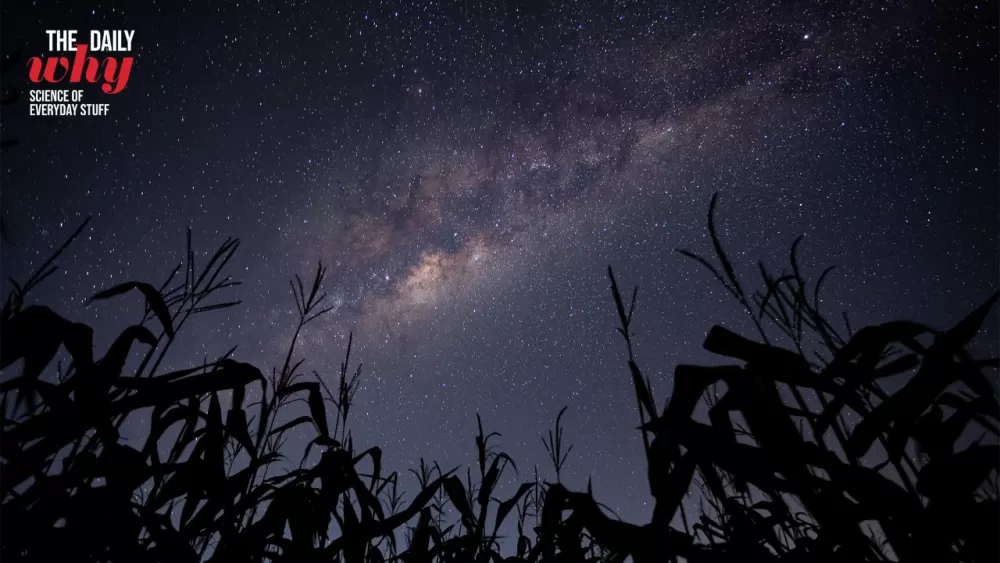
Unveiling the Paradox: Why the Universe, Brimming with Stars, Appears So Black
Ever looked up at the night sky and wondered why it's mostly black, even with billions of stars out there? It's a question that has puzzled thinkers for centuries, and the answers are far more fascinating than you might imagine, diving deep into the very nature of our universe.
It's a question that sounds almost silly at first glance, isn't it? We live in a cosmos teeming with billions upon billions of stars, each one a fiery sun, radiating incredible amounts of light and energy. Our own Sun, for example, absolutely bathes Earth in brilliant daylight. So, logically, shouldn't space itself be a blinding expanse of light, a continuous, shimmering canvas of starlight? Why, then, when we venture out beyond our atmosphere, or simply gaze up on a clear night, does space look so profoundly, majestically dark?
This isn't just some casual observation; it's a profound cosmic puzzle that has stumped scientists and philosophers for centuries. In fact, it's so significant it even has a name: Olbers' Paradox. The thinking went, if the universe were infinite and uniformly filled with stars, then no matter which direction you looked, your line of sight would eventually land on a star. The entire sky should be as bright as the surface of the Sun! Clearly, that's not what we see.
So, what's really going on out there? It turns out, the darkness of space isn't due to a lack of light sources, but rather a combination of incredible, mind-bending factors about the universe itself. Let's peel back the layers of this cosmic mystery.
First off, think about our own blue sky here on Earth. That lovely, vibrant blue? It's not because the sky itself is blue. It's thanks to our atmosphere! The tiny molecules of gas and dust in our air scatter sunlight in all directions. Blue light, with its shorter wavelengths, gets scattered more efficiently, giving our daytime sky its characteristic hue. But in space? There's virtually no atmosphere. It's a vacuum, incredibly sparse. Light travels directly from its source to your eye or a detector without anything in between to scatter it. Unless you're looking directly at a star or a galaxy, there's nothing for the light to bounce off of and illuminate the 'empty' space around it. So, if you're not looking directly at a light source, it appears black.
But that's just part of the story, and arguably the most intuitive part. The deeper, more universe-defining reasons touch upon cosmology itself. One major factor is the finite age of the universe. Believe it or not, the universe hasn't been around forever. It had a beginning – the Big Bang – about 13.8 billion years ago. This means that light from stars and galaxies that are incredibly far away simply hasn't had enough time to reach us yet. We're actually seeing back in time when we look at distant objects, and there's a limit to how far back, and thus how far out, we can see. The light from beyond our observable universe is still on its way, or perhaps never will reach us.
And then there's the universe's incredible, ongoing expansion. The cosmos isn't just sitting still; it's actively stretching and growing, and has been since the Big Bang. As the fabric of space itself expands, the light waves traveling through it get stretched out too. This phenomenon is called redshift. Much like how a siren's pitch drops as it moves away from you, the wavelength of light from distant galaxies gets longer, shifting it towards the red end of the electromagnetic spectrum, and eventually even into the infrared or microwave regions, making it invisible to our eyes. This stretching also diminishes the light's energy, making distant objects appear much, much fainter than they would otherwise.
While cosmic dust and gas clouds do exist, and can absorb some light, they're simply not dense or widespread enough throughout the vastness of the universe to account for the overall darkness. If they were, they'd heat up and re-emit light themselves, which would bring us back to a similar problem of a bright sky.
So, the next time you gaze up at the night sky, take a moment to appreciate that profound blackness. It's not empty, nor is it devoid of light. Instead, it's a silent testament to the incredible, dynamic nature of our universe: its age, its expansion, and the sheer, mind-boggling emptiness that allows light to travel billions of years to reach our eyes, yet keeps the vast in-between remarkably dark.
- India
- News
- Space
- NASA
- ScienceNews
- Environment
- EnvironmentNews
- JamesWebbSpaceTelescope
- Astronomy
- Stars
- Galaxies
- Universe
- CosmicMystery
- Redshift
- AstronomyFacts
- CosmicMicrowaveBackground
- UniverseExpansion
- ExpansionOfTheUniverse
- Light
- LightScattering
- UniverseAge
- NasaScience
- ExpansionOfUniverse
- OlbersParadox
- RedshiftExplained
- WhyIsTheNightSkyBlack
- WhyIsSpaceDark
- DarkSpace
- WhySpaceIsDark
- FiniteAgeOfUniverse
Editorial note: Nishadil may use AI assistance for news drafting and formatting. Readers can report issues from this page, and material corrections are reviewed under our editorial standards.


