
The Curious Case of Asteroid Torifune: A Contact Binary Revealed
- Nishadil
- July 08, 2026
- 0 Comments
- 3 minutes read
- 18 Views
- Save
- Follow Topic
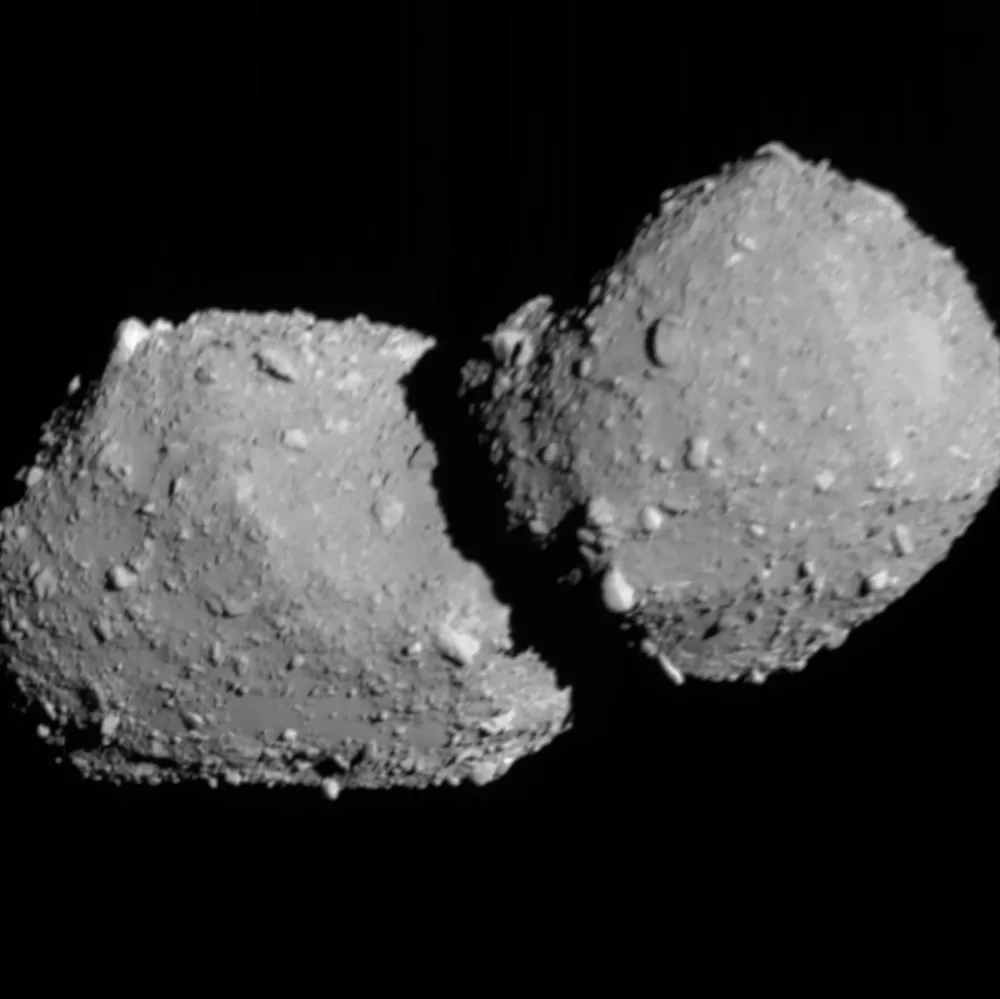
Astronomers spot a rare “touching” asteroid, shedding light on solar‑system evolution
New observations show that the near‑Earth asteroid Torifune is actually a contact binary—two lobes stuck together—offering fresh clues about how rocks grow in space.
When the team at the Mauna Kea Observatory pointed their high‑resolution camera at Torifune last summer, they weren’t expecting a surprise. The little, roughly 300‑meter rock had been catalogued for years as a simple, roughly spherical asteroid, nothing more exciting than a drifting speck. Yet the images that came back were anything but ordinary.
What we saw was two distinct lobes, a sort of cosmic peanut, literally touching each other at a narrow neck. In other words, Torifune is a contact binary—a pair of bodies that have gently bumped together and stuck, rather than smashing into a single, mashed‑up lump.
Now, that might sound like a trivial detail to a layperson, but for planetary scientists it’s a big deal. Contact binaries are relatively rare among the near‑Earth population, and each one serves as a natural laboratory for how asteroids coalesce, how they respond to tidal forces, and even how planetary defense strategies might need to adapt.
“When we first ran the shape‑model software, the data just wouldn’t fit a single ellipsoid,” said Dr. Lena Morrow, the lead author of the study published in Nature Astronomy. “It was as if the computer kept shouting ‘no, this isn’t right!’ – so we dug deeper, and the two‑lobed picture emerged.”
The discovery relied on a combination of radar imaging from Goldstone and optical data from the Subaru telescope. By stitching together echoes that bounced off the rock’s surface, the team reconstructed a three‑dimensional model that revealed a clear neck, roughly 20 meters wide, connecting the larger western lobe (about 190 meters across) to a smaller eastern companion (just 110 meters).
Why does this matter? For one, contact binaries are thought to be the building blocks of larger bodies. In the early solar system, dust and rock clumped together in a low‑gravity dance, sometimes ending up as these joined pairs. Studying them can tell us about the conditions that prevailed billions of years ago.
Moreover, the shape has practical implications. A binary structure behaves differently when you try to nudge it with a kinetic impactor—a leading idea for deflecting a dangerous asteroid. The momentum transfer could be less efficient, or the impact might even split the two lobes apart, creating a new hazard.
Torifune’s orbit also adds intrigue. It swings close enough to Earth every few years to be observable, yet it never poses a collision threat. That makes it an ideal test case for future missions that might land, drill, or even retrieve a sample.
“We’re already talking about a possible fly‑by mission in the next decade,” Morrow added. “If we can get a close look at the neck region, we might learn how these bodies stick together—whether it’s just gravity, or if there’s some cement‑like material at play.”
For now, the asteroid continues its quiet trek around the Sun, a reminder that even the smallest objects can surprise us. The next time you glance up at the night sky, think about the hidden peanut‑shaped rock hanging out there, patiently waiting for the next set of eyes to notice its quirks.
Editorial note: Nishadil may use AI assistance for news drafting and formatting. Readers can report issues from this page, and material corrections are reviewed under our editorial standards.


