Consistent Hashing Explained: A Practical Guide for Distributed Systems
- Nishadil
- October 22, 2026
- 0 Comments
- 6 minutes read
- 4 Views
- Save
- Follow Topic
Why Consistent Hashing Is a Game‑Changer When Scaling Out Your Services
A down‑to‑earth look at consistent hashing, how it solves the pitfalls of naïve modulo hashing, and why virtual nodes make the whole thing smoother.
Imagine you have a cache spread across a handful of machines. You need a way to decide which key lives where. The most obvious idea is to take the key’s hash, apply a mod with the number of servers, and you’re done. Simple, right? In reality that approach turns into a nightmare as soon as you add or drop a node – almost every key ends up on a different machine.
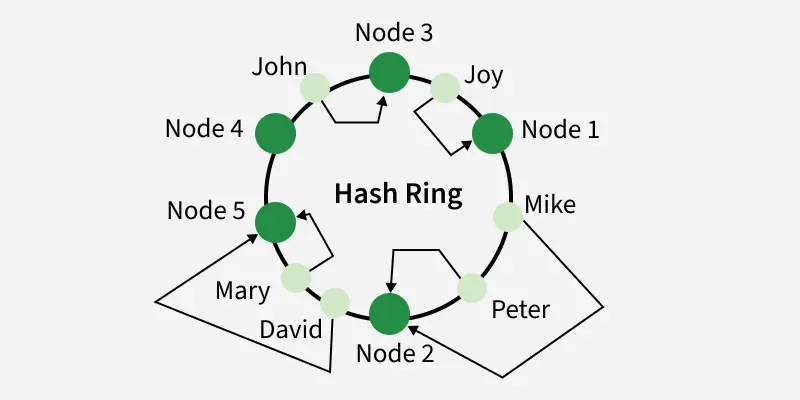
Enter consistent hashing. Instead of a flat modulo table, you picture a big circle – the hash ring – where both servers and data keys sit after being run through the same hash function. When a key needs a home, you walk clockwise until you hit the first server; that server owns the key. The beauty is that only the keys that fall between the new server’s position and its predecessor have to move. Everything else stays put.
What makes this matter? First, minimal key remapping. If you add a brand‑new node, only the slice of the ring it now owns is reshuffled – a tiny fraction of the total keyspace. Second, the method scales naturally; you can keep sprinkling nodes onto the circle without rewriting a single line of routing logic. Third, it spreads load more evenly, especially when you bring virtual nodes into the picture.
Traditional hashing, by contrast, looks like this:
serverIndex = hash(key) % numberOfServers;
When numberOfServers changes, the modulo result changes for almost every key. That means a massive data movement, a spike in network traffic, and—worst of all—a dip in cache‑hit rates while the system re‑balances.
Consistent hashing solves those three pains in one fell swoop. Let’s walk through the mechanics.
How Consistent Hashing Works
1. Create the hash ring. Think of the full range of a 32‑bit (or 64‑bit) hash as a circle. Zero sits next to the maximum value, completing the loop.
2. Place servers on the ring. Each server gets an identifier – often its IP or hostname – and you hash that identifier. The resulting number marks the server’s position.
3. Map keys to the ring. When a request arrives, you hash the key (the cache key, a user ID, whatever) and locate that point on the circle.
4. Assign the key. Move clockwise until you meet the first server; that server becomes the owner of the key.
5. Handle churn. Adding a node inserts a new point; only the keys that fall between the new node and its predecessor shift to the newcomer. Removing a node simply hands its keys to the next server clockwise.
Adding and Removing Servers
Adding a server is almost painless. Say you drop a new machine into the pool; you hash its name, plot it on the ring, and claim the slice that lies between it and the previous node. Only those keys need to be relocated – everything else continues to hit the same servers as before.
Removing a server – perhaps because of a failure – works the opposite way. The ring skips the missing point, and the keys that used to belong to the vanished node get handed to the next live node clockwise. No other keys are disturbed, so the system stays largely stable while you spin up a replacement.
Virtual Nodes: Smoothing Out the Rough Edges
If each physical machine occupies just one spot on the ring, the distribution can be uneven – imagine a lucky node landing in a densely populated region while another lands in a desert. The fix is to give each real server many “virtual nodes” (or vnodes). You hash the server’s identifier plus an index (e.g., ServerA_0, ServerA_1, …) multiple times, scattering those points around the circle.
Virtual nodes bring several perks:
- Better load balancing, because each physical server now covers many small slices.
- Less impact when a node joins or leaves – the ring’s shape changes only locally.
- You can weight servers differently by assigning more vnodes to more powerful machines.
A Minimal C++ Implementation
Below is a compact example that demonstrates the core ideas – a ring backed by std::map for ordered look‑ups and a set of virtual node hashes.
#include <bits/stdc++.h>
using namespace std;

class ConsistentHashRing {
private:
    map<size_t, string> ring;           // hash → node name
    set<size_t> sorted_keys;               // ordered hash values for fast lookup
    int replicas;                         // how many virtual nodes per physical node

    size_t get_hash(const string &value) const {
        return hash<string>{}(value);
    }

public:
    explicit ConsistentHashRing(int replicas = 3) : replicas(replicas) {}

    // Add a physical node (creates replicas virtual positions)
    void add_node(const string &node) {
        for (int i = 0; i < replicas; ++i) {
            size_t vnode_hash = get_hash(node + "_" + to_string(i));
            ring[vnode_hash] = node;
            sorted_keys.insert(vnode_hash);
        }
    }

    // Remove a physical node (deletes all its virtual positions)
    void remove_node(const string &node) {
        for (int i = 0; i < replicas; ++i) {
            size_t vnode_hash = get_hash(node + "_" + to_string(i));
            ring.erase(vnode_hash);
            sorted_keys.erase(vnode_hash);
        }
    }

    // Given a key, locate the responsible node
    string get_node(const string &key) const {
        if (ring.empty()) return "";
        size_t h = get_hash(key);
        auto it = sorted_keys.lower_bound(h);
        if (it == sorted_keys.end()) it = sorted_keys.begin(); // wrap‑around
        return ring.at(*it);
    }
};

int main() {
    ConsistentHashRing ch(4); // four virtual nodes per server
    ch.add_node("Node_A");
    ch.add_node("Node_B");
    ch.add_node("Node_C");

    string key = "first_key";
    cout << "Key '" << key << "' maps to " << ch.get_node(key) << "\n";
    return 0;
}
The code is intentionally straightforward – it hashes both nodes and keys with C++’s standard std::hash, stores the positions in an ordered map, and then walks the sorted set to find the first node clockwise. In production you’d replace std::hash with a stronger function (like MurmurHash3 or xxHash) and add replication for fault tolerance.
In a nutshell, consistent hashing lets you grow or shrink a cluster with a single line of code, keeps most keys glued to the same machines, and evens out load with virtual nodes. That’s why it shows up everywhere from distributed caches (Memcached, Redis Cluster) to peer‑to‑peer storage systems and even DNS load‑balancers.
- India
- News
- Technology
- TechnologyNews
- Scalability
- LoadBalancing
- DistributedSystems
- HashFunction
- ScalableArchitecture
- Picked
- CImplementation
- DatabaseSharding
- ConsistentHashing
- DataDistribution
- NodeFailureHandling
- EfficientDataMovement
- CachingSystems
- KeyReplication
- VirtualHashRing
- HighRehashingOverhead
- FailureRecovery
- HashFunctionSelection
- HashRing
- VirtualNodes
- NodeAddition
- NodeRemoval
Editorial note: Nishadil may use AI assistance for news drafting and formatting. Readers can report issues from this page, and material corrections are reviewed under our editorial standards.