
Ancient Korea's Hidden Secrets: A Mass Grave Reveals Human Sacrifice and Deep Isolation
- Nishadil
- April 10, 2026
- 0 Comments
- 4 minutes read
- 36 Views
- Save
- Follow Topic
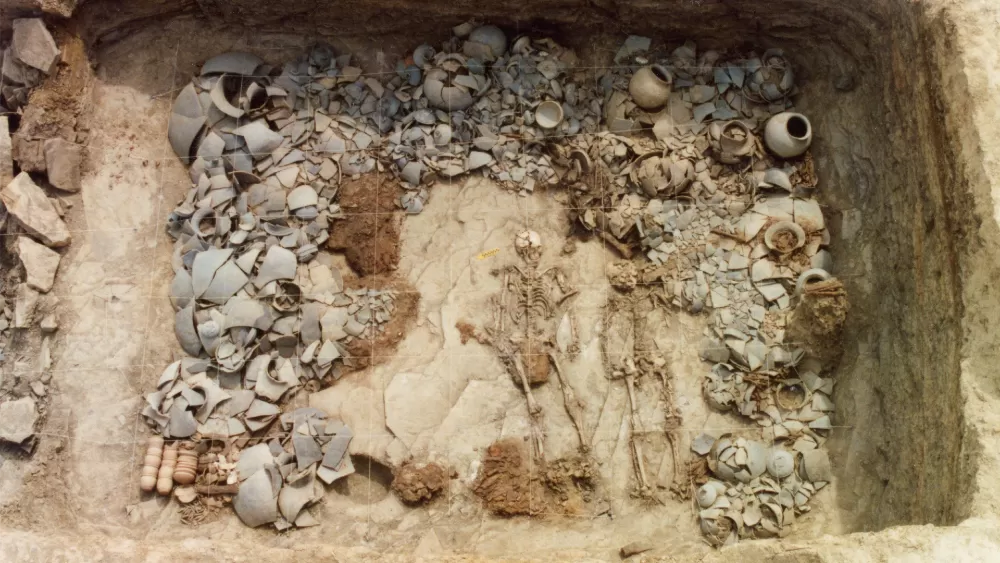
A Chilling Discovery in Ancient Korea Unveils Ritual Sacrifice and a Society Marked by High Inbreeding
Archaeologists have unearthed a mass burial site in ancient Korea, providing compelling evidence of ritual human sacrifice and an unexpectedly isolated society grappling for power.
Imagine, if you will, the scene: a quiet archaeological dig in what is now modern-day South Korea, and then, slowly, meticulously, a team unearths something truly unsettling. What they found wasn't just another burial site, but a grim tableau from the distant past – a mass grave where lives met brutal, violent ends. We're talking about a discovery that paints a stark, perhaps even shocking, picture of an ancient Korean society, one grappling with both ritual human sacrifice and a surprising degree of genetic isolation.
For centuries, the Gaya Confederacy, a loose collection of city-states nestled on the southern tip of the Korean Peninsula, existed in the shadow of its more dominant neighbors, particularly the powerful Silla Dynasty. It was a time of political fluidity, of emerging elites, and often, of fierce rivalry. And it's precisely within this tumultuous period, specifically from the 5th and 6th centuries AD, that archaeologists in Gimhae, South Korea, stumbled upon the Yuha-ri site – a place that would soon rewrite parts of what we thought we knew about these ancient communities.
What they uncovered there was, frankly, chilling. At least 39 individuals lay interred, their skeletal remains bearing witness to incredibly violent demises. We're not talking about battlefield casualties here; many showed clear signs of intentional brutality – decapitations, dismemberment, and severe blunt force trauma. It really makes you pause and wonder about the circumstances that led to such an horrific scene. Were these enemies? Criminals? Or something far more complex?
But the real eye-opener, the piece of the puzzle that truly deepened the mystery and our understanding, came from the cutting-edge genetic analysis. Scientists from Seoul National University, scrutinizing the ancient DNA, made some truly remarkable observations. Firstly, there was an incredibly high level of inbreeding among these individuals. This wasn't just a few related people; it suggested a deeply isolated population, perhaps a small, tightly-knit community or even an elite group maintaining its distinctiveness.
And here’s where it gets even more fascinating, and frankly, a bit unsettling. Unlike what one might instinctively assume – that the sacrificial victims were outsiders, perhaps foreign captives or marginalized individuals – the genetic evidence told a different story entirely. The victims were, by and large, genetically indistinguishable from the local general population. This wasn't about "them" versus "us" in terms of ethnicity or origin; these were local people, chosen from within the community itself for what must have been incredibly significant, if brutal, ritualistic purposes.
So, why such a grim practice, and why then? Human sacrifice wasn't a common or widespread custom in ancient Korea during this era. Its appearance at Yuha-ri, particularly in a period marked by political upheaval and the rise of new powerful groups, suggests a deliberate and potent statement. Researchers propose that these acts of sacrifice might have been a tool for the nascent Gaya elites, a dramatic and terrifying way to solidify their authority, display their power, and perhaps even invoke divine favor during a period of intense struggle and consolidation.
Ultimately, this extraordinary discovery at Yuha-ri doesn't just add a dark chapter to ancient Korean history; it reshapes our understanding of social structures, political strategies, and ritualistic beliefs in the Gaya Confederacy. It reminds us that history is rarely simple, often complex, and full of surprising turns. The bones speak volumes, revealing a society that, in its quest for stability and power, resorted to practices that resonate with both awe and a profound sense of human tragedy, giving us a rare and poignant glimpse into a world long past.
Editorial note: Nishadil may use AI assistance for news drafting and formatting. Readers can report issues from this page, and material corrections are reviewed under our editorial standards.


