A Trio of Worlds Unveiled: Astronomers Peer into the TOI-500 System
- Nishadil
- April 16, 2026
- 0 Comments
- 4 minutes read
- 26 Views
- Save
- Follow Topic
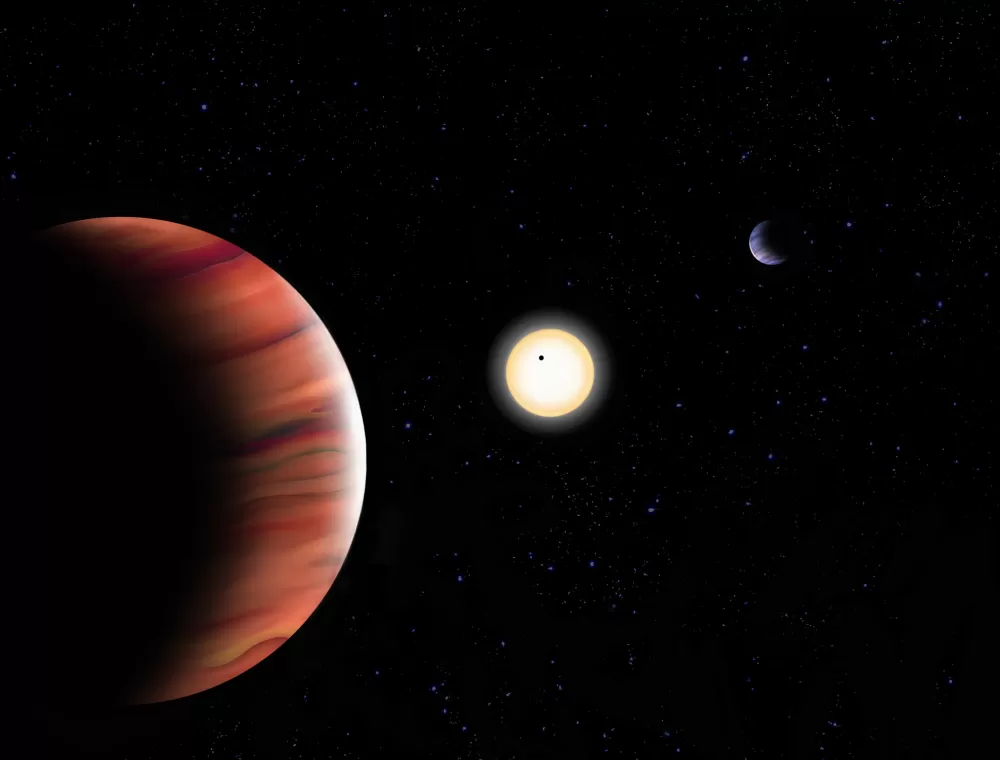
Astronomers Confirm Three Planets Orbiting Distant Star TOI-500, Offering New Insights into Planetary Formation
Our universe just got a little more crowded, thanks to astronomers confirming a fascinating multi-planet system dubbed TOI-500. This trio of worlds, ranging from a super-Earth to mini-Neptunes, orbits a relatively cool M-dwarf star, providing a unique cosmic laboratory to study how planets come to be.
It's always thrilling to hear about new planetary discoveries, isn't it? The universe, it seems, is far from empty, and our understanding of it grows richer with each new finding. Recently, astronomers have turned their gaze to a captivating system known as TOI-500, confirming the existence of not one, but three distinct planets circling a star that's quite different from our own Sun. This discovery, made possible through a remarkable collaborative effort, is a genuinely significant step in piecing together the grand puzzle of planetary formation.
At the heart of this freshly characterized system lies TOI-500, a type of star we call an M-dwarf. Now, these M-dwarfs are smaller and cooler than our Sun, and honestly, they're quite common throughout the galaxy. But what's truly fascinating is how different planetary systems can look when they form around such stars. This particular star hosts three confirmed exoplanets, each offering its own intriguing characteristics for scientists to pore over. It’s a bit like finding a perfectly preserved, miniature solar system far, far away.
Let's talk about the innermost world, shall we? It's known as TOI-500 b, and it's what we affectionately call a 'super-Earth.' Imagine a planet larger than our own blue marble, but still smaller than the ice giants like Neptune. That’s TOI-500 b for you. Orbiting incredibly close to its star, it whips around in a mere 1.2 days – talk about a short year! You can just imagine the blistering temperatures on its surface; definitely not a vacation spot, I'm afraid. This proximity also means it’s tidally locked, much like our Moon is to Earth, always showing the same face to its star.
Moving outwards, we encounter TOI-500 c and TOI-500 d. These two are classified as 'mini-Neptunes.' They're bigger than our super-Earth, but, as their name suggests, considerably smaller than our Solar System's Neptune. TOI-500 c completes an orbit every 2.7 days, while TOI-500 d takes a slightly longer 6.1 days. What's truly intriguing about these planets is their specific sizes and orbital arrangements, especially how they relate to the M-dwarf star. They offer astronomers a unique opportunity to test various theories about how planets grow and migrate into their final positions within a system.
So, how did we spot these distant worlds? The journey began with NASA's Transiting Exoplanet Survey Satellite, or TESS. TESS is designed to observe large swathes of the sky, looking for tiny dips in starlight that indicate a planet passing in front of its star – a phenomenon we call a transit. Once TESS flagged TOI-500 as a potential multi-planet system, the real detective work began. Scientists then used follow-up observations from the European Space Agency's CHEOPS mission, which provided incredibly precise measurements of the planet sizes. To determine their masses, and thus their densities, the ESPRESSO instrument on the ESO's Very Large Telescope was employed, measuring the minute wobbles in the star caused by the planets' gravitational tug. It’s a magnificent blend of space-based and ground-based astronomy, truly.
You see, finding systems like this isn't just about adding numbers to a catalog; it's about understanding the very fabric of our cosmos. The TOI-500 system, with its three closely-packed planets orbiting an M-dwarf, provides a crucial testbed for models of planet formation and evolution. Are these planets where they formed, or did they migrate inwards over billions of years? What kind of atmospheres might they possess, given their sizes and proximity to their star? These are the kinds of profound questions that discoveries like TOI-500 help us to answer, piece by fascinating piece.
The work doesn't stop here, of course. Future observations, perhaps with instruments like the James Webb Space Telescope, could potentially reveal more about the atmospheres of these worlds. Every new system we discover around M-dwarfs, which are the most common stars in our galaxy, brings us closer to understanding the true diversity of planets out there. It reminds us just how dynamic and surprising the universe truly is, constantly challenging our preconceptions and inviting us to explore further. And that, in my humble opinion, is one of the most exciting aspects of being human.
- UnitedStatesOfAmerica
- News
- Technology
- Australia
- UnitedKingdom
- Singapore
- Science
- ScienceNews
- TechnologyNews
- Physics
- Exoplanets
- SuperEarth
- PlanetFormation
- Materials
- AstronomyDiscoveries
- MiniNeptune
- TessMission
- MDwarfStar
- NanoTech
- PhysicsNews
- Toi500System
- MultiPlanetSystem
- CheopsMission
- EspressoInstrument
Editorial note: Nishadil may use AI assistance for news drafting and formatting. Readers can report issues from this page, and material corrections are reviewed under our editorial standards.