
A Mathematical Triumph: Solving the Sphere Packing Enigma in Higher Dimensions
- Nishadil
- April 19, 2026
- 0 Comments
- 4 minutes read
- 25 Views
- Save
- Follow Topic
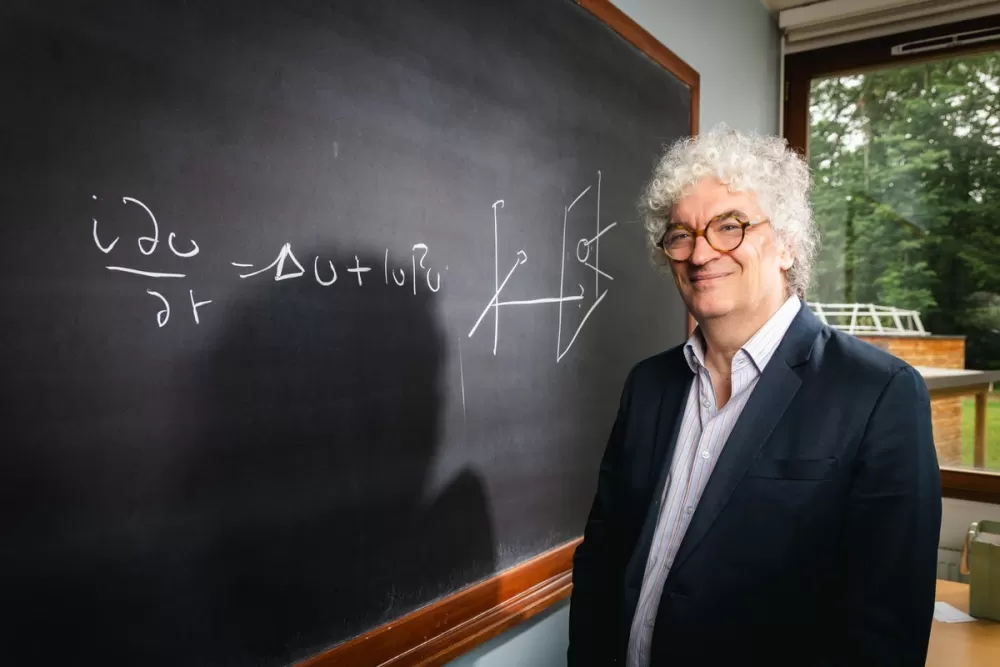
Maryna Viazovska Wins $3 Million Math Prize for Revolutionary Sphere Packing Solution
Meet Maryna Viazovska, the brilliant mathematician who captivated the world by cracking a centuries-old problem: how to most efficiently pack spheres in higher dimensions, earning her a prestigious $3 million Breakthrough Prize.
There are some problems in mathematics that just... well, they feel like they’ve been around forever, quietly challenging the brightest minds across generations. The sphere packing problem is absolutely one of them. For centuries, people have pondered the most efficient way to stack spheres – think of oranges in a grocery store, but then imagine it in dimensions beyond our everyday experience. And now, a brilliant mathematician named Maryna Viazovska has not just made a dent, but effectively blew the doors off a significant chunk of this puzzle, earning herself a monumental $3 million Breakthrough Prize in Mathematics.
It’s truly a staggering achievement, isn't it? Viazovska, a professor at the Swiss Federal Institute of Technology Lausanne, was recognized for her groundbreaking work that precisely answered how to pack spheres as densely as possible in eight and, later, in twenty-four dimensions. If those numbers sound a bit abstract, don’t worry, you’re in good company! The problem itself has a deceptively simple premise, but its solution quickly spirals into some incredibly complex, beautiful mathematics. For our familiar three dimensions, the solution was proven only in 1998 by Thomas Hales, confirming a conjecture that dated back to Johannes Kepler in the 17th century. So, solving it for eight and twenty-four dimensions? That’s truly next level.
What makes her work particularly fascinating is the elegance and unexpected nature of her solution. Back in 2016, Viazovska published a paper that tackled the eight-dimensional case. It was so remarkably concise and self-contained that it immediately sent ripples of excitement through the mathematical community. Mathematicians, myself included, often marvel at such "perfect" proofs – where every piece fits just so, revealing a deep underlying structure. Her approach involved something rather intriguing: the use of "modular forms" and connections to exceptional Lie groups. Without getting too bogged down in the specifics (trust me, they are deep), imagine mathematical objects that possess a profound, almost magical symmetry, allowing them to perfectly describe the optimal sphere arrangements.
Initially, Viazovska, then a postdoc at Humboldt University of Berlin, solved the 8-D problem. But she didn't stop there. Almost immediately after, collaborating with a team of fellow mathematicians, she extended her methods to crack the 24-D case. It was an astonishing one-two punch that solidified her place as a major figure in modern mathematics. Her technique, sometimes colloquially referred to as "blowing up equations," doesn't literally involve explosions, of course! Instead, it’s a sophisticated way of constructing certain mathematical functions that, when properly defined, prove that no denser packing exists than the one she found. It’s a testament to incredible insight and painstaking intellectual rigor.
The Breakthrough Prizes, often dubbed the "Oscars of Science," are a big deal, established by tech titans like Sergey Brin and Mark Zuckerberg to celebrate fundamental achievements in life sciences, physics, and mathematics. They not only provide substantial financial recognition but also bring much-needed attention to the often-unsung heroes of scientific discovery. Viazovska’s win is particularly inspiring, not just for the sheer brilliance of her work, but also as a powerful example for aspiring mathematicians everywhere, especially women in STEM. It highlights that the most profound insights often come from looking at old problems with fresh eyes, armed with new mathematical tools and an unwavering curiosity.
So, the next time you see a carefully stacked pyramid of oranges, perhaps spare a thought for Maryna Viazovska. Her work reminds us that even in the seemingly abstract world of higher-dimensional geometry, there's profound beauty, elegance, and incredible intellectual adventure to be found. And sometimes, it takes a "master of chaos" to bring order and clarity to the most stubborn mathematical enigmas.
Editorial note: Nishadil may use AI assistance for news drafting and formatting. Readers can report issues from this page, and material corrections are reviewed under our editorial standards.


